

Manufacturers that produce wire components at medium or high volumes often find that output is limited less by machine capacity than by the process around it: parts are loaded and positioned by hand, moved between separate forming steps, and adjusted repeatedly, so every shift introduces its own variation. CNC wire forming automation addresses these constraints by linking feeding, positioning, bending, forming and cutting into one programmable workflow. This article explains where production efficiency is lost in traditional wire forming, how automated wire forming recovers it, and what to evaluate before automating your process.
The intent is practical: we look at the production steps that can be automated, how CNC control improves consistency, the components that benefit most, and the questions to answer before choosing an automatic wire forming machine. The right decision depends on your product geometry, wire specifications and production volume, not on any generic trend.
What Is Wire Forming Automation?
In practical manufacturing terms, wire forming automation means replacing operator-controlled forming steps with a machine that executes a stored program. An automated wire forming process can integrate the operations of feeding, straightening, positioning, bending, rotating or forming, cutting and finished product output into one continuous workflow. Instead of an operator measuring and positioning each piece, the machine draws wire from the coil, moves it to the correct position, forms each bend in sequence and cuts the finished component to length.
The capabilities that make this possible are the same ones used across modern CNC equipment: CNC control stores the forming sequence and coordinates every axis; servo motors deliver accurate, repeatable motion for feeding, bending and rotation; automatic wire feeding keeps material moving through the machine without manual attention; and multi-axis movement allows bends in multiple planes. Programmable forming sequences mean that changing products is a matter of changing the program and tooling rather than reworking a fixture. The exact process depends on the product and machine configuration, so automation is designed around the component.
Where Does Production Efficiency Get Lost in Traditional Wire Forming?
Before deciding how to automate, it helps to identify exactly where efficiency disappears in a manual or semi-manual process. The sources below are common across wire component production.
Repetitive Manual Handling
Every wire component has to be picked up, positioned against a tool or template, formed, checked and set aside. At low volumes this is acceptable; at medium and high volumes the handling repeats thousands of times per order. Loading, positioning and handling consume labor and production time without adding value, and fatigue makes each repetition slightly less accurate.
Multiple Separate Processing Steps
When a wire component requires bending plus other operations such as punching or twisting, manufacturers often move the part between different machines. Every transfer adds handling, positioning and setup time, and each new fixture introduces its own reference point. The more a component is moved, the more chances there are for dimensional variation between steps.
Manual Adjustment
Manual forming depends on the operator checking the result and adjusting the next attempt. Bending, measuring, correcting and trying again is slow, and the correction is based on the last part rather than a stable process parameter. Manual adjustment affects consistency because the reference moves with each operator and attempt.
Limited Production Scalability
Manual processes become difficult to scale when order volume increases. Adding output means adding operators, workbenches and floor space, while cycle time per part stays the same or worsens. This does not mean manual production is always unsuitable: for prototypes, low-volume work and products that change constantly, it can remain the correct choice. The limitation appears when the same product must be repeated in growing volume with consistent quality.
How CNC Wire Forming Automation Improves Production Efficiency
Automation improves efficiency by removing the sources of loss described above, one by one. The five mechanisms below are the core of a wire forming automation system, and they work together rather than in isolation.
1. Automates Repetitive Production Steps
An automatic wire forming machine executes feeding, positioning, bending, cutting and forming according to the program, so the operator supervises the process instead of performing each movement. Automated feeding draws the wire from the coil, automated positioning places it accurately for every bend, and automated cutting separates the finished part. Reducing repetitive manual operations improves workflow efficiency directly, and it also removes the fatigue-related errors that accumulate over a shift.
2. Reduces Unnecessary Material Handling
Integrated processing reduces the need to transfer components between different production stages. When feeding, forming and cutting happen on one machine in one sequence, the part is handled once at the start and once at the end, instead of being moved between workstations. Less handling means less time, less re-fixturing and fewer opportunities for parts to be damaged or mispositioned during transfer.
3. Improves Production Consistency
CNC-controlled parameters hold feeding position, bending angle, forming sequence and product dimensions constant from the first part of a batch to the last. In a manual process, positioning depends on the operator's eye and force depends on the operator's hands; in an automated process, both are defined numerically in the program. The result is that variation shifts from operator skill to mechanical repeatability, which is far more predictable and far easier to audit.
4. Supports Complex Multi-Axis Forming
Multiple CNC axes can coordinate bending, rotation, cutting and, where the machine is configured for it, punching and twisting or forming operations. This is what makes three-dimensional wire components practical to produce: the part is rotated between bends so that each bend lands in the correct plane, and the machine performs the rotation automatically. A multi-axis wire forming machine therefore handles components that are difficult or impractical to form consistently by hand.
5. Makes Production More Repeatable
Repeatability matters most for automotive and industrial component suppliers, whose customers run their own lines at fixed takt times and expect every delivered batch to match the approved sample within tolerance. A programmable process supports this in a way a manual one cannot: the same program reproduces the same part whenever it is reloaded, parameters are documented for quality audits, and variation between shifts and operators is minimized. For suppliers that must demonstrate process control, repeatability is itself a qualification advantage.
Automotive Applications of CNC Wire Forming Automation
Automotive manufacturing is where automated wire forming delivers some of its clearest results, because vehicle components are produced in large volumes, must be dimensionally consistent, and often combine several forming operations. The applications below are supported by Belan's actual product information; more context is available on the automotive parts wire forming solution page.
Automotive Seat Frame Wire
Seat frames, rear seat wire frames, seat support structures, foam wire and automotive linkage components are typically long, symmetrical wire assemblies that must be identical on the left and right sides. Belan forms these on the BL-2T-15600, a 15-axis dual-head CNC wire bending machine whose two synchronized heads form both ends of a long workpiece in a single cycle. Long and symmetrical wire components benefit from automated forming because the two sides stay dimensionally consistent and the cycle time is much shorter than forming each end separately.
Foam Seat Support Wire and Fuel Tank Float Rod
Small-diameter wire applications such as foam seat support wires and fuel tank float rods are produced on the BL-3D-6250 6-axis CNC wire bending machine, which is designed for small-diameter wire processing. These parts are small but geometrically demanding, with bends in multiple planes, which is exactly where multi-axis CNC control justifies automation over manual forming.
Automotive Wiper Linkage Arms
Wiper linkage arms are produced on the BL-YG-12A wiper linkage arm forming machine, a 12-axis CNC machine designed for flat steel material of 4mm x 9mm and 4mm x 12mm. It integrates automatic feeding, bending, punching, cutting and inner twisting or forming into one machine. A wiper linkage arm is not a pure bending product: it combines bends with punched features and twisted sections, and doing all of these operations on one machine avoids the handling and re-fixturing that a multi-step manual process would require.
Automotive Wire Mesh Components
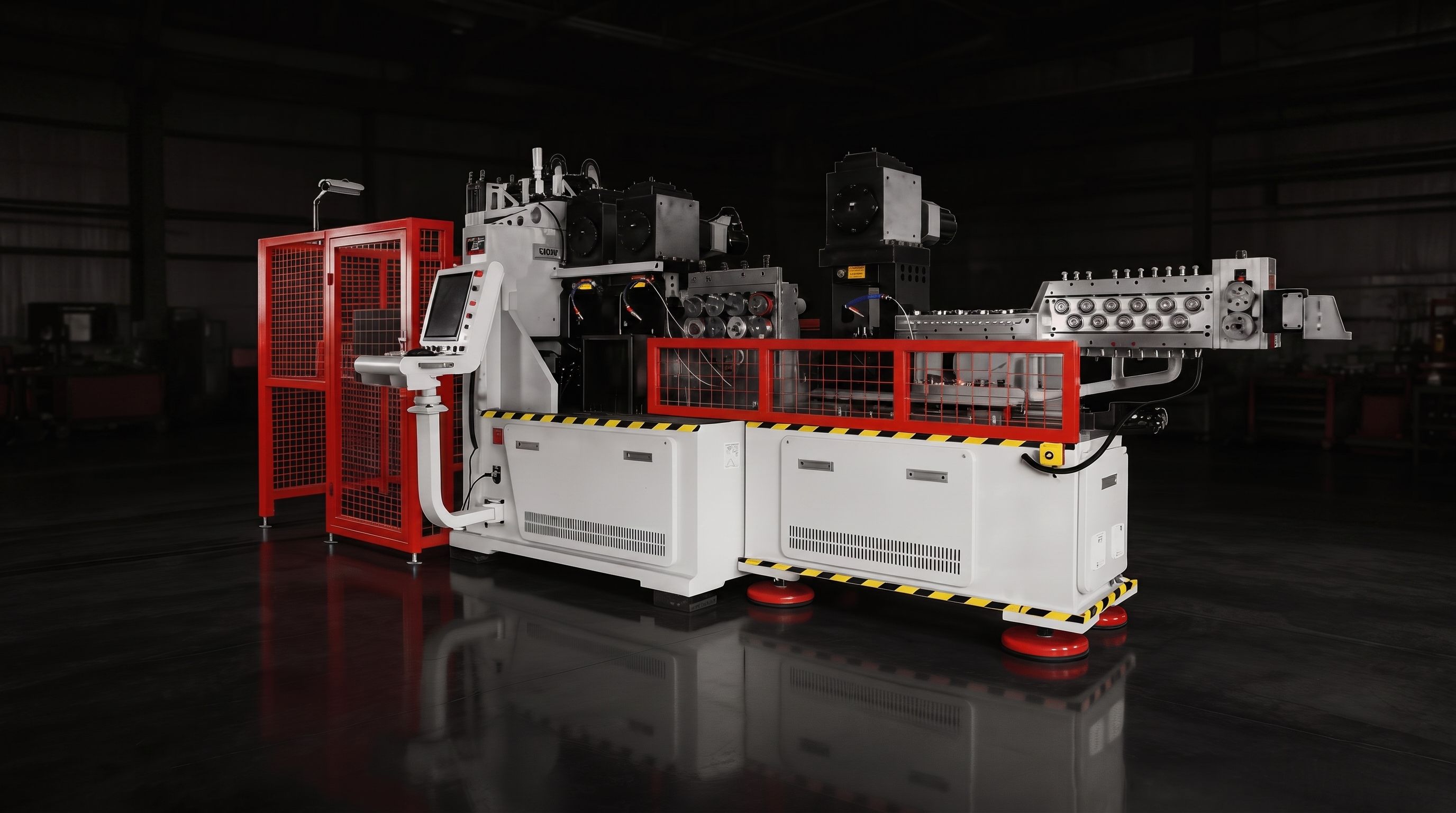
Wire mesh components such as the grid structures used inside automotive seat frames require a specialized approach. The BL-WG-2030S wire mesh forming machine combines automatic feeding, grid forming, cutting and finished product collection in one process, and is a clear example of automation replacing repetitive manual assembly with a continuous forming workflow, as documented in the automotive seat grid plate bending case study.
Automation Beyond Automotive Wire Components
The same wire forming automation principles apply beyond automotive wherever wire is formed repeatedly at volume. Industrial wire components, hardware products, electrical components and special-profile wire applications can all be produced on automated forming equipment when geometry and volume justify it. The machine must be configured for the material and the forming operations, which is why suppliers match equipment to the application. Belan's automation experience also covers integrated non-standard production lines and EV copper and aluminum busbar processing solutions, showing that the same design logic transfers across forming applications.
Key Technologies Behind Efficient Wire Forming Automation
Efficiency in wire forming automation comes from specific technologies working together. Understanding them helps buyers compare machines on substance rather than on axis counts alone.
Multi-Axis CNC Control
Multi-axis CNC control coordinates the movements of feeding, bending, rotation and forming according to a stored program. Because every movement is defined numerically, the machine produces the same geometry on every cycle, and product changes are handled by programming rather than by rebuilding fixtures.
Servo-Driven Positioning
Servo motors provide controlled feeding and positioning, which determines where every bend lands along the wire. Accurate feeding locates bend positions; accurate positioning controls the angle of each bend. The servo system is what turns a program into a dimensionally consistent part, and its stability over long runs is a core factor in production reliability.
Automatic Wire Feeding
Automatic wire feeding draws material continuously from the coil, which supports automated production by removing the need to measure and feed wire by hand. Combined with automatic cutting, it allows the machine to produce one part after another with minimal operator attention between cycles.
Integrated Forming Operations
When bending, punching, twisting or cutting operations are integrated into one machine and one program, the component is formed in a single workflow instead of moving between stations. Integration is what reduces handling and setup time, and it is the main reason automated forming is faster than a sequence of manual steps.
How to Evaluate a Wire Forming Automation Solution
Selecting the right wire forming automation solution starts with documenting the product and the process, not with comparing machines. The checklist below covers the information a supplier needs to recommend a suitable configuration.
- Wire material. Soft wire, hard wire, stainless steel and plastic-wrapped or coated wires behave differently during feeding and bending. Confirm the machine and tooling suit your material.
- Wire diameter or material dimensions. For round wire, match the soft and hard wire diameter ranges; for flat material, note the section dimensions. Running at the edge of a published range invites forming problems.
- Product geometry. Count the planes of the bends and the overall part length. Flat parts suit 2D machines; parts with bends in several planes require multi-axis 3D capability.
- Number of forming operations. Define whether the part needs bending only, or also punching, twisting or other operations that must be integrated into the forming sequence.
- Required CNC axes. Select the axis configuration that covers the required movements, no more and no less. Extra axes add capability but also cost.
- Production volume. Medium and high volumes justify automatic feeding and continuous cycles; very low volumes may not. Be realistic about current and projected demand.
- Feeding requirements. Consider coil weight, feeding accuracy, feeding speed and whether the material needs special handling such as straightening or wrapping.
- Tooling and changeover. Consider how often products change, how quickly programs and tooling can be swapped, and the supplier's support for application-specific tooling.
- Finished product accuracy. Specify the tolerances your parts must meet and confirm the machine's feeding and bending accuracy can hold them.
- Auxiliary equipment. Decide whether the line needs automatic part collection, feeding stands, quality checking stations or other equipment to support continuous production.
The guiding principle is that automation should be designed around the actual product and production process. A machine selected from a catalog without reference to the component and the volume is likely to be either over-specified or under-specified for the job.
How to Improve Efficiency Without Over-Automating
Manufacturers should not simply choose the machine with the most functions or the highest number of axes. A 15-axis machine is not a better purchase than a 6-axis machine if the parts only need planar bends; the extra capability is paid for but never used. The correct solution should match product complexity, production volume, wire specifications, required operations, changeover frequency and quality requirements.
Appropriate automation is more valuable than unnecessary automation. In practice this means defining the minimum axis count that covers the forming operations, choosing automatic feeding where volume justifies it, and keeping changeover simple where the product mix changes often. It also means keeping manual forming for prototypes and short-run specials while automating repeatable high-volume parts — many plants run a mixed floor, and that is usually the most efficient arrangement.
Belan CNC Wire Forming Solutions
Belan's CNC wire forming machine range covers the main scenarios described in this article, from small-diameter 3D bending to dual-head forming of long components and specialized integrated forming. The machines below show how configuration follows the application.
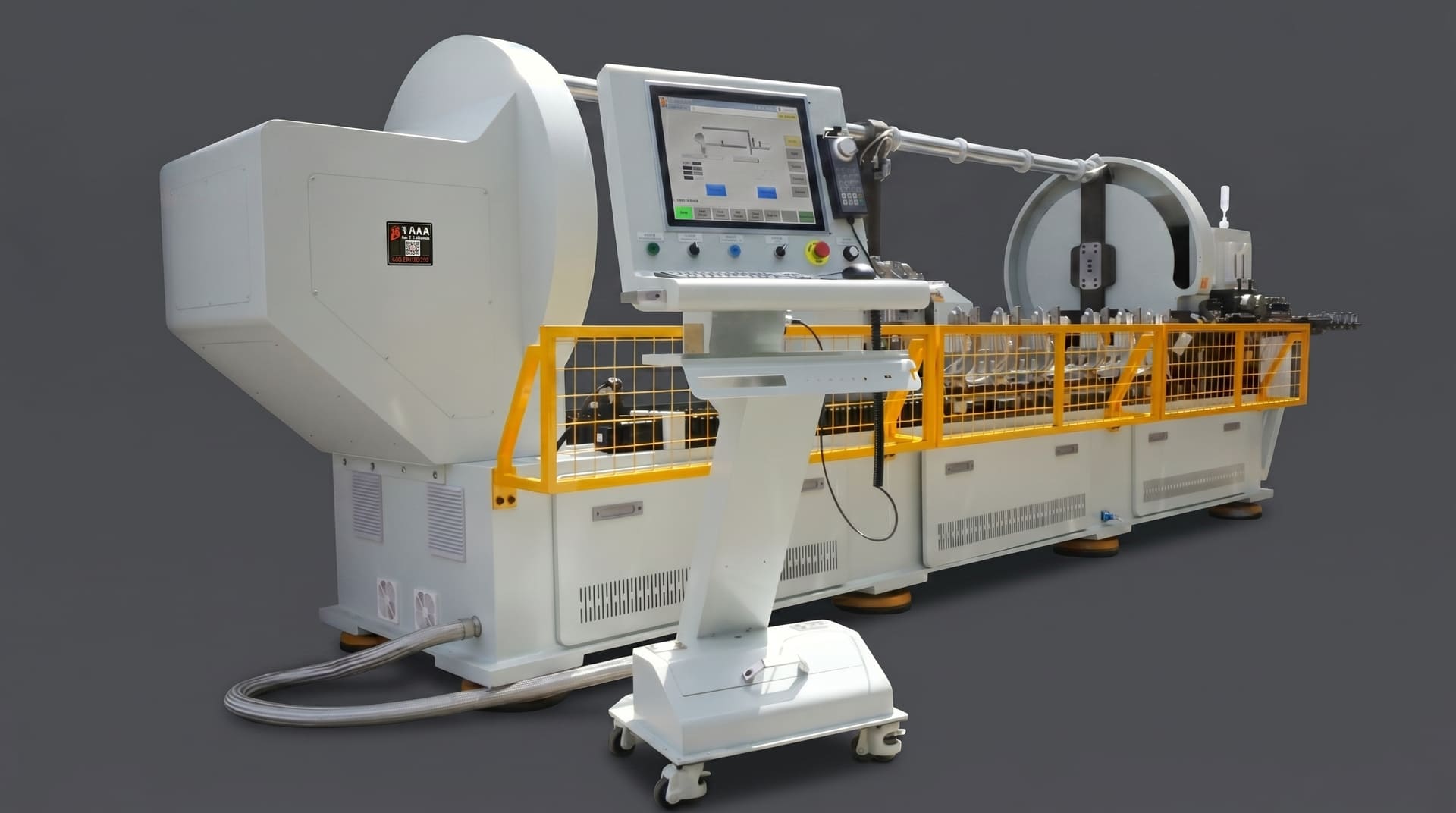
The BL-2T-15600 is a 15-axis dual-head CNC wire bending machine for long and symmetrical automotive wire components. It processes soft wire from Φ3.0 to 6.0 mm and hard wire from Φ3.0 to 4.5 mm, with a maximum processing length of 2000 mm and 26.9 kW total power. The two synchronized heads form both ends of a workpiece in a single cycle, keeping both sides dimensionally identical and shortening the cycle for seat frames, rear seat wire frames and similar long components.
The BL-3D-6250 6-axis CNC wire bending machine is designed for small-diameter wire processing: soft wire from Φ1.6 to 3.5 mm and hard wire from Φ1.6 to 2.5 mm, with a 580 mm bending stroke and 5.6 kW total power. Its multi-axis control performs complex three-dimensional bends while maintaining dimensional consistency, making it a practical choice for foam seat support wires, fuel tank float rods and other precision small wire components.
The BL-YG-12A 12-axis wiper linkage arm forming machine is designed for flat steel material of 4mm x 9mm and 4mm x 12mm. With 12-axis control and 55.9 kW total power, it integrates automatic feeding, bending, punching, cutting and inner twisting or forming, which makes it the single-machine solution for wiper linkage arms and similar combined-forming components.
The BL-WG-2030S automotive wire mesh forming machine handles W-shaped steel wire of Φ2.0 mm and plastic-wrapped steel wire of Φ3.0 mm, with 28 to 34 axes and 30 kW total power. It integrates automatic feeding, forming, cutting and collection for automotive seat frame grid applications. It is a specialized forming machine for wire mesh structures, not a general-purpose wire bending machine, which is why it is matched specifically to grid products.
Conclusion
Effective wire forming automation can help manufacturers reduce repetitive manual operations, streamline production steps, improve consistency, support complex forming, increase production efficiency and build more scalable manufacturing processes. The value of automation is not in the technology itself but in how closely it matches the actual component, the wire specifications and the production volume. Manual forming remains a legitimate choice for prototypes and low-volume work, and the best production floors usually combine both approaches.
If you are evaluating wire forming automation for your production, start by documenting your wire specifications, product drawings and production requirements, then contact Belan to discuss them and receive a suitable CNC wire forming solution matched to your application.
Frequently Asked Questions
What is CNC wire forming automation?
CNC wire forming automation is the use of computer-controlled machinery to perform wire forming steps such as feeding, positioning, bending, forming and cutting without manual intervention. A stored program coordinates multi-axis servo movement, so the same program produces the same part on every cycle and products are changed by reprogramming rather than rebuilding fixtures.
How does CNC automation improve wire forming efficiency?
Automation improves efficiency by removing the sources of loss in manual forming: automated feeding, positioning, forming and cutting replace repetitive manual operations, integrated processing reduces handling between stages, and repeatable CNC-controlled production reduces rework. Cycle time is governed by the machine rather than by operator speed, and consistency does not depend on the operator on duty.
What automotive components can be produced with automated wire forming?
Supported applications include seat frames, rear seat wire structures, foam wires, wiper linkage arms, automotive linkage components and wire mesh seat structures. Each component is matched to a machine configuration: long symmetrical parts to dual-head forming, small-diameter parts to 6-axis machines, and combined bending, punching and twisting parts to integrated 12-axis machines.
Can one automated wire forming machine perform multiple operations?
Some Belan machines integrate multiple operations, such as the BL-YG-12A, which combines feeding, bending, punching, cutting and inner twisting or forming in one machine. The exact capabilities depend on the machine configuration and the product requirements, so the machine should be selected according to the forming operations the part actually needs.
How do I choose the right wire forming automation solution?
Start by documenting the wire material, dimensions, product geometry, production volume, required forming operations, finished product accuracy and the level of automation you need. The correct solution matches these factors rather than the machine with the most functions. Sharing product drawings and production data with the supplier helps match the configuration.
Can Belan customize a CNC wire forming solution?
Yes. Belan can recommend suitable machine configurations and forming solutions based on product drawings, material specifications and production requirements. Sharing your wire specifications and target output helps confirm the correct machine class, axis configuration and tooling before any investment decision.