

Introduction
Even when a CNC wire bending machine follows the programmed angle exactly, the finished part can still measure a few degrees off target once the wire is released. For manufacturers running seat frame wire, foam wire, linkage components, or other high-volume wire parts, this is a persistent source of dimensional deviation, rework, and batch-to-batch inconsistency.
The cause is springback: the elastic recovery that occurs in the wire after the bending force is removed. Springback is a material behavior, not an operator error, and it cannot be machined away — but it can be measured, compensated for, and controlled consistently. This guide explains where springback in CNC wire bending comes from, which factors influence it, and the practical methods that keep bending accuracy and forming consistency under control in modern CNC wire bending machines.
What Is Springback in CNC Wire Bending?
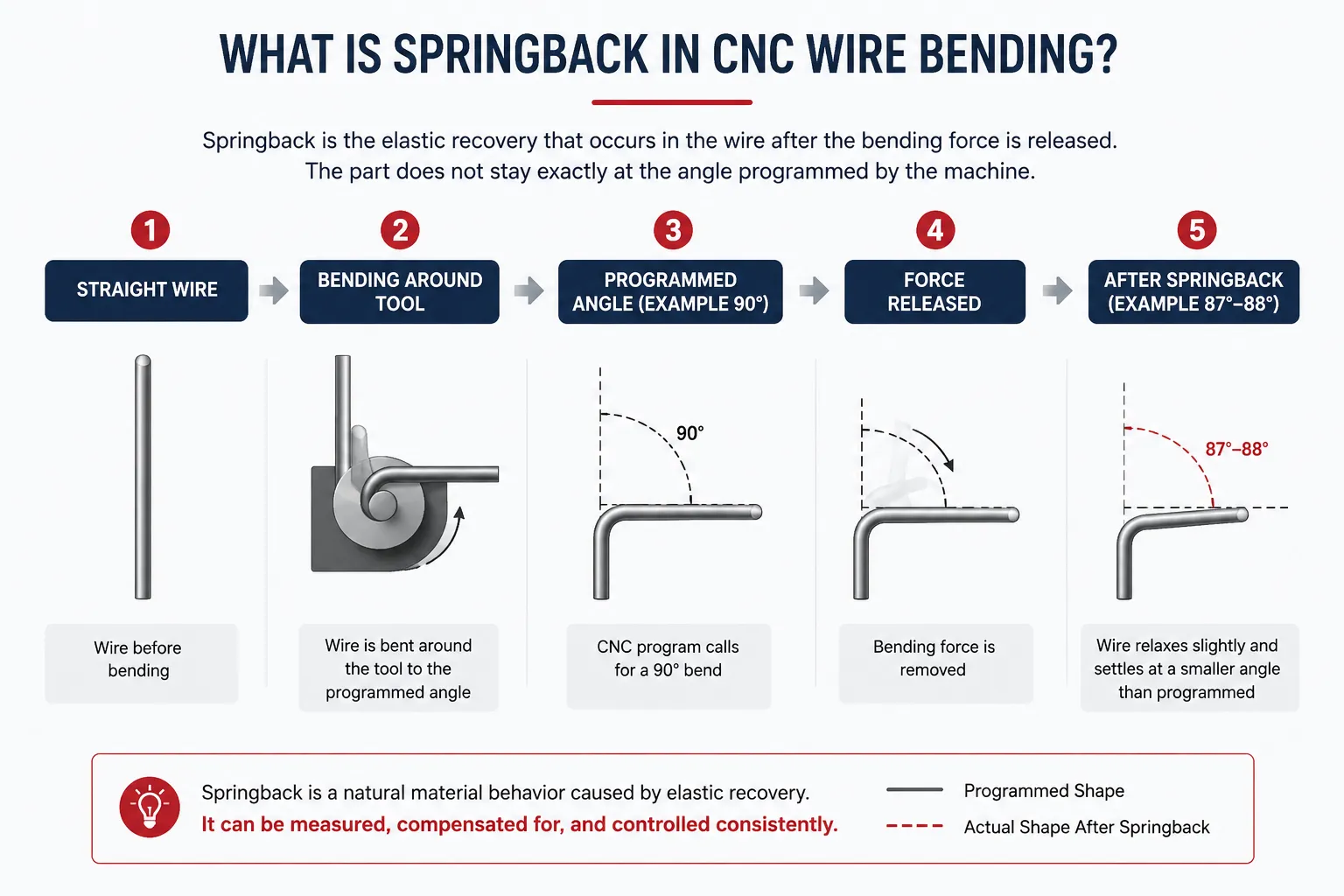
When a straight wire is bent around a tool, the outside of the bend is stretched while the inside is compressed. Part of this deformation is plastic (permanent) and part is elastic. The plastic portion gives the wire its new shape; the elastic portion is stored energy that recovers when the bending force is released, so the bend relaxes slightly.
In practice, a wire programmed to 90 degrees may spring back and settle at 87 or 88 degrees, and the formed radius may open slightly larger than the tool radius. The part is bent — just not exactly to the geometry the program called for.
The amount of recovery differs from material to material: a hard-drawn steel wire typically recovers more than a soft annealed wire of the same diameter, and spring wire, stainless steel, and low-carbon steel can each behave differently under identical bending conditions. Understanding this is the starting point for controlling it.
Why Does Springback Occur During Wire Bending?
Springback is rooted in the elastic portion of deformation, but the size of that portion depends on a combination of material and process factors:
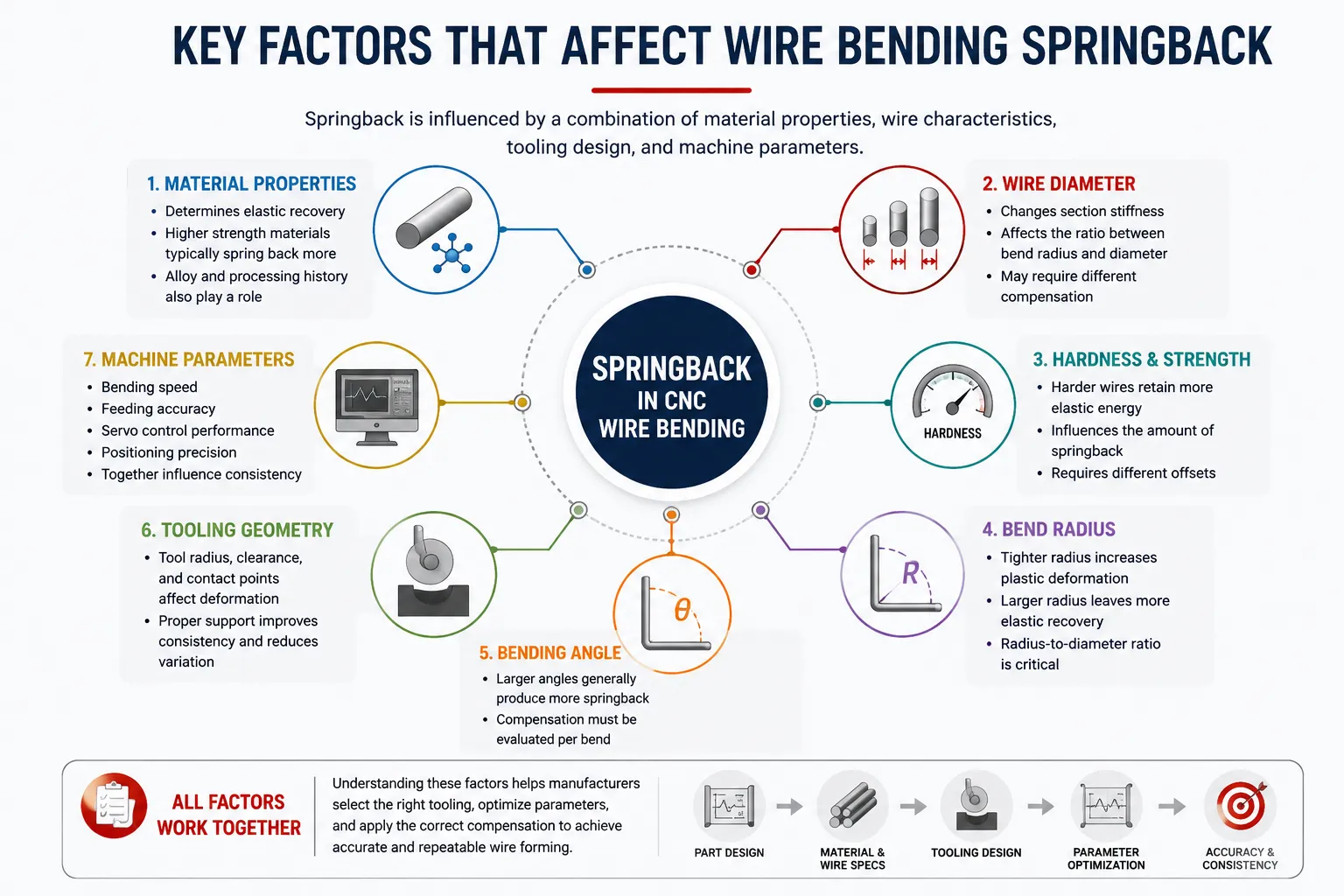
Material properties and hardness. Harder, higher-strength materials generally retain more elastic energy during forming, which can translate into greater recovery once the load is removed. The exact amount depends on alloy, temper, and processing history, so two visually identical wires may not bend identically.
Tensile and yield strength. Materials with higher yield strength relative to stiffness typically exhibit more springback, because a larger share of the deformation remains elastic. The same part geometry may therefore need different compensation when the wire grade changes.
Wire diameter. Diameter changes the stiffness of the wire section, and the ratio between bend radius and diameter in particular determines how much elastic recovery is built into the bend — a process variable, not just a drawing dimension.
Bend radius and bending angle. A tight radius generally forces more of the section into plastic deformation, while larger radii and angles can leave proportionally more elastic recovery. Compensation therefore has to be evaluated bend by bend, not assumed from the material alone.
Tooling geometry and forming method. How the wire is supported, constrained, and wrapped during forming affects how predictably it deforms. Different forming methods and tooling layouts can produce different recovery behavior on the same part.
Bending speed and machine parameters. Forming speed, feeding accuracy, and positioning behavior can all influence how consistently the wire reaches its intended geometry. Their effect is usually smaller than material factors but still contributes to variation in precision work.
Key Factors That Affect Wire Bending Springback
The table below summarizes the main factors and what each one means on the production floor:
| Factor | How It Affects Springback | Manufacturing Consideration |
|---|---|---|
| Material | Determines the elastic recovery characteristic of the bend | Keep wire grade and temper consistent between batches |
| Wire Diameter | Changes section stiffness and deformation severity | Re-validate compensation when diameter changes |
| Hardness | Harder wires typically retain more elastic recovery | Request material certificates and test each new lot |
| Bend Radius | Radius-to-diameter ratio influences relative recovery | Balance formability, tooling and fatigue requirements |
| Bending Angle | Compensation scales with the angle being formed | Establish offsets per bend, not per part |
| Tooling | Affects how the wire is constrained during forming | Inspect for wear; recalibrate after changes |
| CNC Parameters | Control angle, feed and motion consistency | Document proven parameter sets for reuse |
How Springback Affects Wire Forming Accuracy
Left unmanaged, springback shows up in several ways: bend angles fall outside tolerance, overall dimensions drift, and assembly problems appear when parts must fit jigs, welding fixtures, or mating components. Rejection rates climb, and operators spend time on manual correction the forming process should have handled.
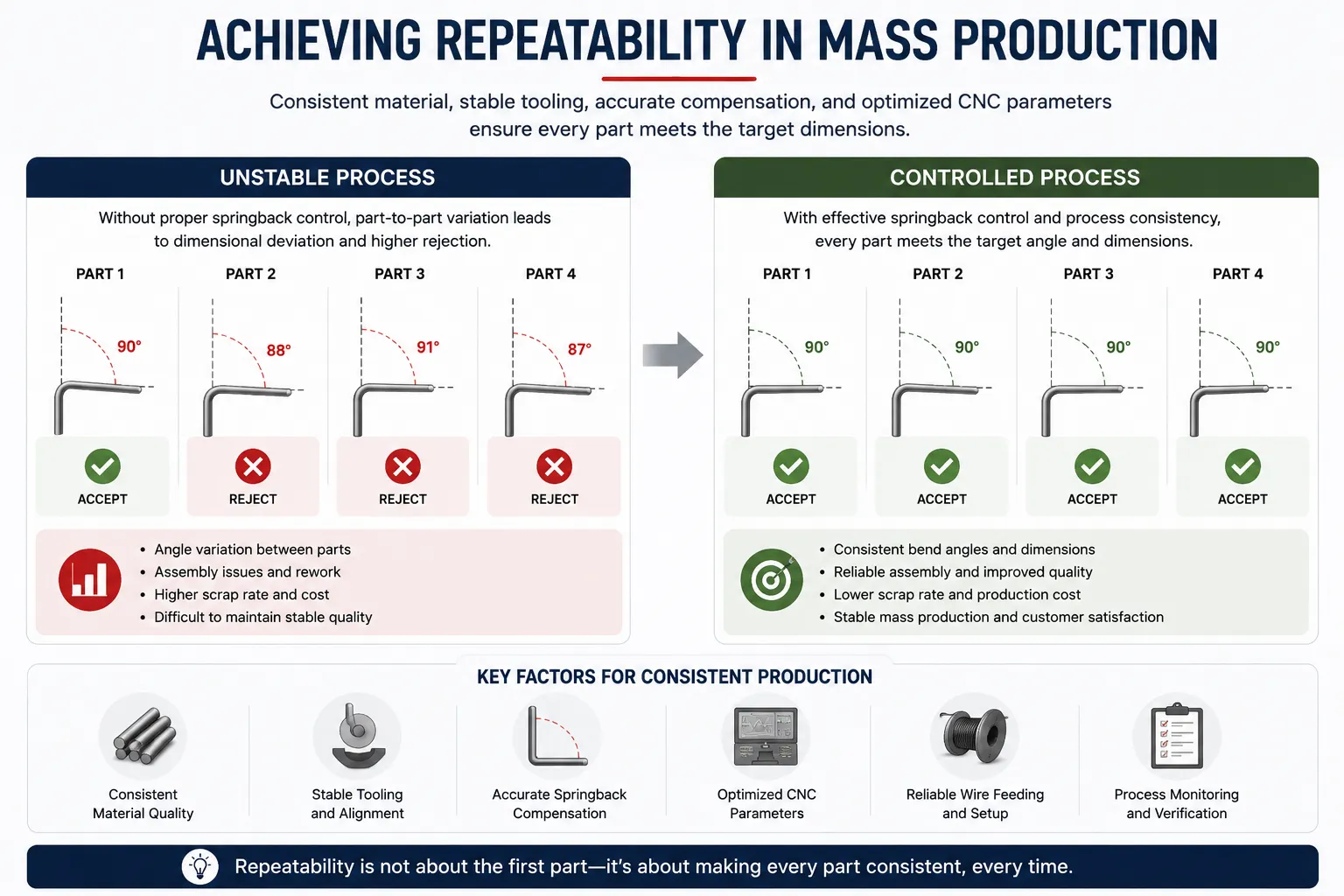
The larger challenge in volume production is not one out-of-tolerance part — it is part-to-part variation. When material lots change, tooling wears, or parameters are adjusted by feel instead of data, wire bending accuracy becomes unstable from shift to shift. For B2B wire products, forming consistency — repeatability — is what separates an acceptable supplier from a difficult one.
How to Control Springback in CNC Wire Bending
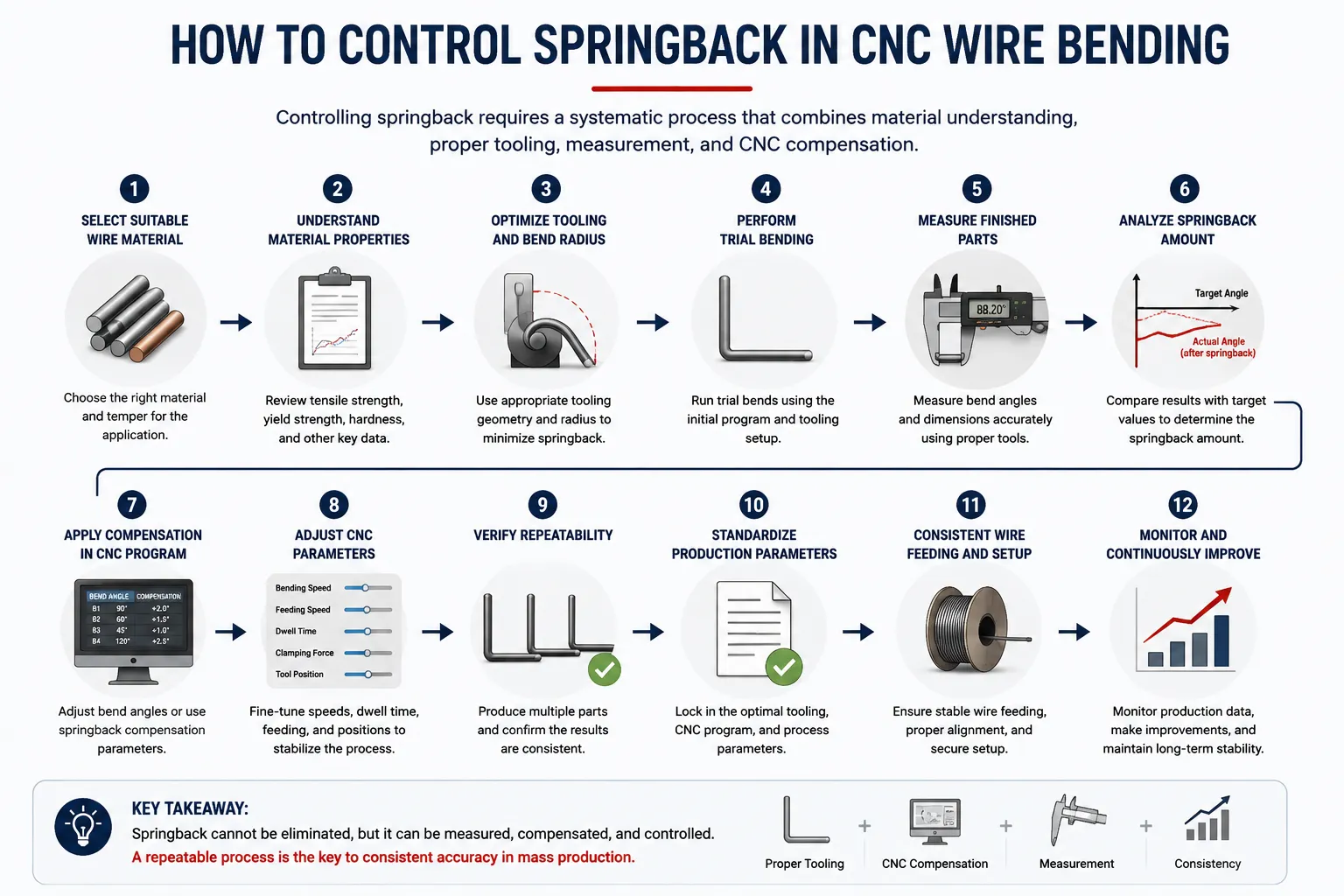
Springback control is a workflow, not a single setting. The following methods each address a different part of the problem, and together they form a repeatable process:
1. Select suitable wire material. Consistent springback starts with consistent material. Specify grade, temper, and surface condition clearly, and avoid mixing lots within one production run.
2. Understand material properties before programming. Obtain hardness and tensile data for the actual wire in use. Compensation from a reference material may not transfer to a different lot, so treat each new material as a new starting point.
3. Optimize bend radius. Radius affects how much deformation remains elastic. Design bends that balance formability, tooling life, and functional requirements rather than defaulting to the largest radius available.
4. Optimize tooling geometry. Tooling determines how the wire is supported and constrained during forming. Well-matched tooling makes deformation more predictable, which in turn makes springback compensation more stable.
5. Use over-bending when appropriate. If a bend reliably springs back two degrees, bending slightly past the target lets the part recover onto the drawing dimension — valid only when recovery is consistent.
6. Establish springback compensation parameters. Build a documented offset for each bend based on measured results rather than assumptions. Treat these values as process data that belongs to the part number.
7. Adjust CNC bending parameters. Bend angle, feeding, and motion parameters interact with the material's recovery behavior; tuning them to the actual wire and recording the result turns trial and error into a defined process.
8. Perform trial bending. First-article trial bends with production wire reveal how the material behaves before a full batch is committed — essential whenever material, tooling, or geometry changes.
9. Measure finished parts. Verify angles and dimensions with appropriate measurement methods — angle gauges, fixtures, or vision measurement depending on tolerance. Measurement closes the loop between predicted and actual springback.
10. Record and standardize production parameters. Once a parameter set produces conforming parts, lock it in. Documented parameters make results repeatable across operators and shifts, and shorten changeover on repeat orders.
11. Maintain consistent wire feeding. Feeding variation shifts where each bend starts, changing effective geometry even when angles are correct. Consistent feeding protects overall wire forming accuracy.
12. Use multi-axis coordination where required. Complex 3D wire parts bend in multiple planes, and each plane can carry its own recovery behavior. Coordinated multi-axis motion in modern 3D wire bending machines keeps the whole forming sequence consistent instead of treating each bend in isolation.
How CNC Technology Helps Compensate for Springback
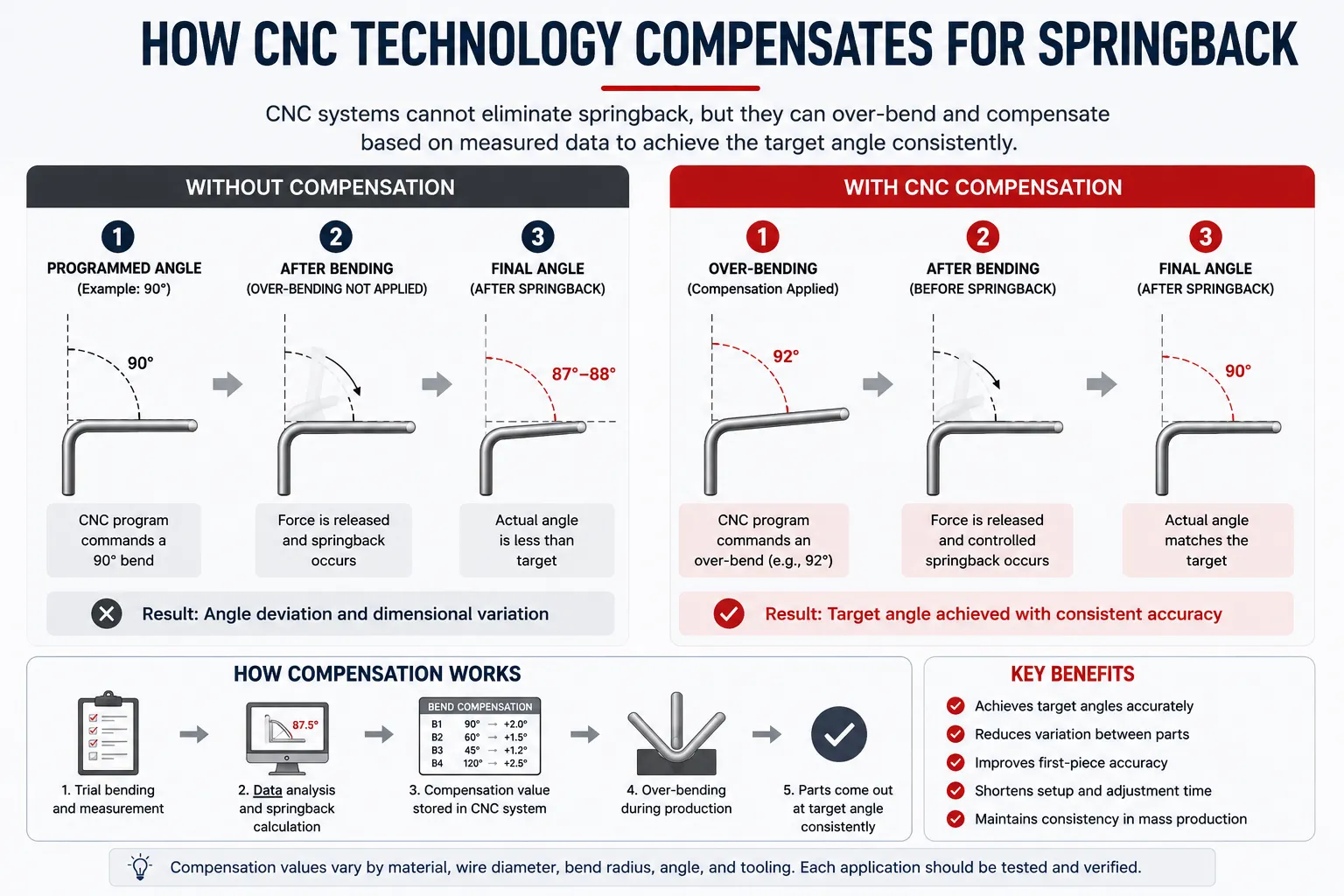
To state this clearly: CNC technology does not eliminate springback. No control system changes how metal stores elastic energy. What CNC systems do is give manufacturers the tools to manage the phenomenon with far more precision than manual methods allow.
Programmable bending parameters let engineers apply a measured compensation angle to each bend, and servo-controlled motion applies it the same way on every cycle. Repeatable feeding and precise positioning keep the bend geometry — and therefore the springback behavior — consistent from part to part, while parameter storage means a proven setup can be recalled exactly rather than rebuilt from memory. CNC systems thus help manufacturers measure, compensate for, and repeatedly control springback — exactly what volume production requires. Machines such as rotary head CNC wire bending machines apply these principles in continuous forming, where consistent tooling contact and controlled rotation support stable bending accuracy.
The Role of Tooling in Springback Control
Tooling is where springback theory meets the actual wire. Tool geometry determines how the material is wrapped, supported, and released, so two different tool sets can produce noticeably different recovery on the same part. Custom tooling matched to the product's bend radii and wire diameter makes deformation — and therefore compensation values — more predictable.
Tooling condition matters as much as design. Worn or damaged tools change the effective geometry of every bend, so a compensation value that was correct at setup quietly drifts out of validity. A practical rule: whenever tooling is changed, repaired, or worn, re-verify the first parts before releasing the batch.
How to Improve Repeatability in Mass Production
In mass production, springback control succeeds or fails on repeatability. Several habits maintain it: keep wire supply consistent and traceable to the lot; sample-measure parts during the run, not only at setup; maintain tooling on a schedule instead of on failure; and protect proven parameter sets from casual modification. When drift appears, respond with data — measure, compare against the recorded baseline, and adjust compensation deliberately.
These practices apply across industrial wire forming solutions of every scale: a stable process produces stable parts, and every intervention should make the process more stable, not less.
Practical Considerations for Automotive Wire Components
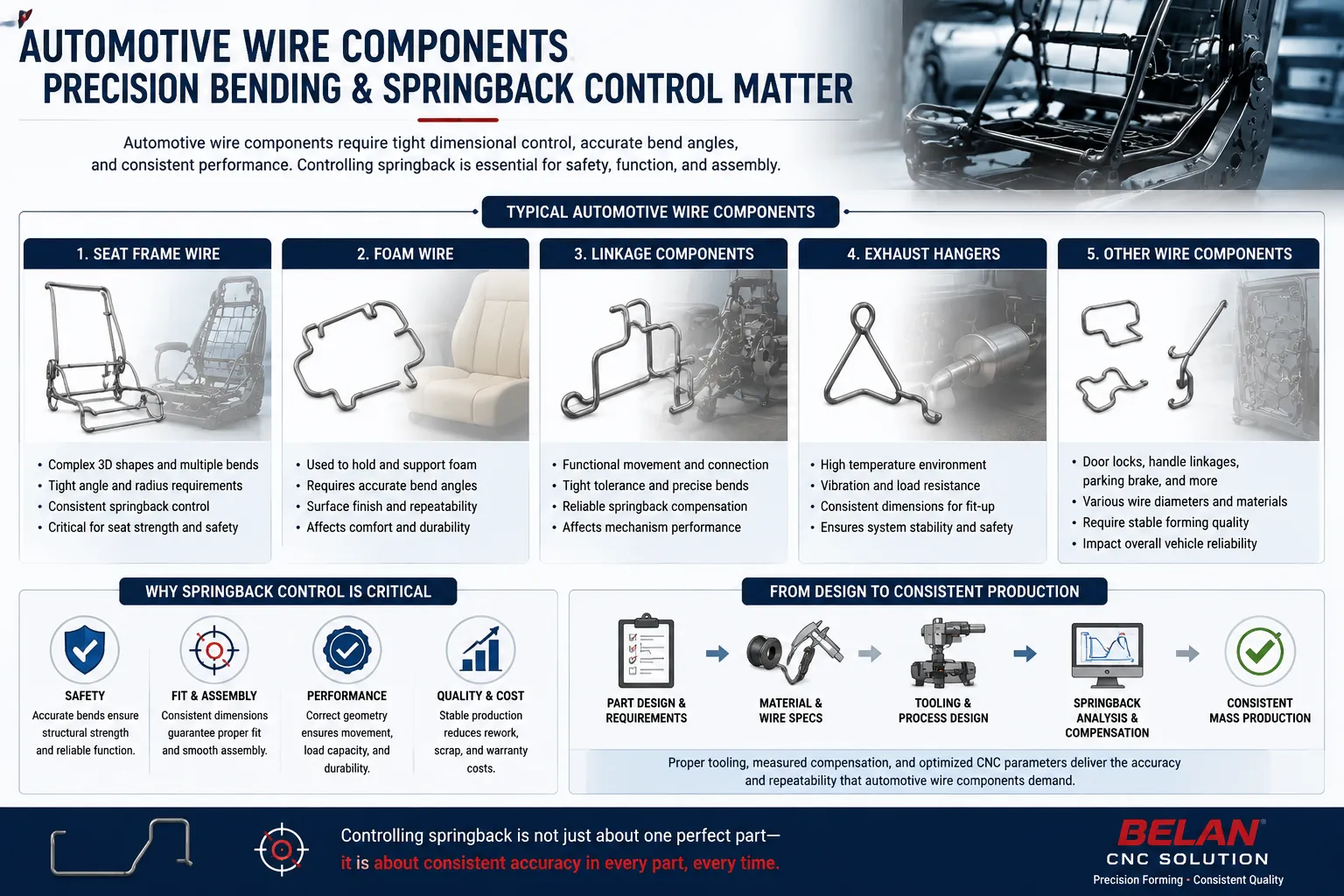
Automotive wire components — seat frame wire, foam wire, seat support structures, linkage and exhaust hanger components — are produced at volumes where consistency is a hard requirement. Many are assembled into fixtures or welded into sub-assemblies, so dimensional deviation in one wire element propagates into the whole assembly, and a seat frame wire that varies slightly per part can slow an entire line.
This is why springback control matters in automotive production: the goal is not just a part within tolerance today, but a process that holds tolerance across thousands of cycles, material lots, and tooling intervals. Manufacturers evaluating an automotive wire forming solution should therefore ask how bending accuracy and forming consistency are verified — not only what the machine can do on a demonstration part.
Springback Control Checklist for CNC Wire Bending
- ☐ Check wire material properties (grade, temper, certificates)
- ☐ Confirm wire diameter and tolerance
- ☐ Review bend radius against formability and tooling limits
- ☐ Evaluate tooling geometry and condition
- ☐ Establish springback compensation parameters per bend
- ☐ Perform trial bending with production wire
- ☐ Measure finished parts against drawing dimensions
- ☐ Record and lock proven production parameters
- ☐ Verify repeatability over a sample production run
- ☐ Standardize the final process and re-validate after any change
How to Evaluate a CNC Wire Bending Solution for Springback Control
When springback control is critical to your parts, evaluate a machine on the capabilities that directly support it: servo precision and repeatability; how bending angles and compensation values are programmed and stored; whether tooling can be matched to your product geometry; whether the supplier can test-bend samples with your actual wire; and what technical support exists after installation. A supplier who asks for your drawings, wire specification, and tolerances before recommending a configuration is evaluating the problem correctly: springback compensation can only be validated against the real material and part.
Why Choose BELAN Machinery for CNC Wire Forming?
BELAN Machinery builds multi-axis CNC wire bending equipment and wire forming solutions focused on automotive applications. BELAN machines combine multi-axis CNC control, intelligent software including AI-assisted springback compensation, and custom tooling matched to the product — the three elements this article identified as central to springback control. BELAN also works from the customer's actual wire specification and product drawings: parts are test-formed and parameters validated before a solution is recommended, so bending accuracy is demonstrated on your part rather than claimed in general terms.
Conclusion
Springback in CNC wire bending is not a defect or a machine fault — it is material behavior that every wire forming process must account for. Successful springback control comes from matching material, wire geometry, tooling, bending parameters, measurement, and compensation as one validated system. CNC technology cannot remove the physics, but it gives manufacturers the programmable parameters, positioning accuracy, and process consistency to compensate for springback reliably — part after part, batch after batch, the foundation of stable, scalable wire component production.
Frequently Asked Questions
What causes springback in CNC wire bending?
Springback is caused by the elastic portion of deformation. When the bending force is released, the wire recovers part of that deformation, so the finished angle opens slightly beyond the programmed angle. How much recovery occurs depends on material, diameter, bend radius, angle, and tooling.
How does material hardness affect wire bending springback?
Harder materials generally retain more elastic energy during forming, which can result in greater recovery after bending. Harder wires may therefore need larger compensation values, and compensation established on a soft wire should not be assumed to transfer to a harder grade.
Can CNC wire bending machines compensate for springback?
Yes — but by compensation, not elimination. A measured offset is programmed into each bend so the part recovers onto the target dimension. With repeatable servo motion, consistent feeding, and stored parameters, that compensation applies identically on every cycle, making results repeatable in production.
How does tooling affect springback?
Tooling geometry determines how the wire is supported and constrained during forming, which affects how predictably it deforms and recovers. Tooling matched to the product's radii and diameter makes compensation more stable, while worn or mismatched tooling makes springback drift — so tooling changes should trigger re-measurement of first parts.
Does wire diameter affect springback?
It can. Diameter changes the stiffness of the wire section, and the ratio between bend radius and diameter influences how much elastic recovery is built into the bend. Any change in diameter is a new process condition requiring fresh trial bends and compensation values.
How can manufacturers improve wire bending accuracy?
Start with consistent material, then build a disciplined workflow: trial bending with production wire, measurement against the drawing, documented compensation parameters, and locked CNC parameter sets. Improving accuracy is less about a single adjustment and more about making the whole process repeatable.
How can springback be controlled during mass production?
Treat it as ongoing process discipline: keep wire lots consistent, sample-measure parts during the run, maintain tooling on a schedule, and re-validate parameters after any material, tooling, or geometry change. When drift appears, adjust compensation based on measurement data rather than operator judgment alone.
Need Help Controlling Springback in Your Wire Forming Process?
BELAN Machinery, a professional provider of automotive wire forming solutions. Send us your product drawings or samples. Our engineering team can evaluate your wire material, forming requirements, tooling considerations, and springback control needs to help identify a suitable CNC wire forming solution.
Contact Belan for a Feasibility AssessmentRelated Resources
- CNC Wire Bending Machines — Multi-axis CNC wire bending equipment built for precise, repeatable forming.
- Industrial Wire Forming Solutions — Application solutions for consistent industrial wire component production.
- Automotive Parts Wire Forming Solution — Wire forming solutions for seat frames, foam wire and linkage components where dimensional consistency is critical.
- What Are the Advantages of a 3D Wire Bending Machine? — How multi-plane 3D forming supports complex part geometry and process consistency.
- How to Choose a CNC Wire Bending Machine — A complete selection guide for evaluating machines, tooling and automation options.