

Manufacturers that produce wire components in increasing volumes often reach a point where manual forming stops scaling: labor costs climb, dimensions drift between operators, and cycle times stay locked to the speed of a pair of hands. An automatic wire bending machine addresses these constraints by replacing operator-dependent positioning and bending with CNC-controlled feeding, forming and cutting. This guide compares the two approaches from a production perspective, explains the real benefits of automation, and helps manufacturers decide when the investment makes sense and which machine suits their parts.
Every wire component starts the same way: coiled wire must be straightened, positioned, bent and cut. A manual process relies on the operator for each step; an automated process executes a stored program that defines feeding, bending and cutting. The practical question is not whether automation is technically superior, but when it becomes the better economic choice.
Manual Wire Forming: How Does the Traditional Process Work?
Manual wire forming produces wire components by hand or with simple assist tools. The operator measures the wire, positions it against a bending jig or template, applies force, checks the angle, and adjusts where the part does not match the drawing. Skilled operators can produce good parts this way, and in certain situations the process remains entirely appropriate.
Manual forming is still a reasonable choice for low-volume production, prototypes and sample parts, simple wire shapes with one or two bends, and frequent one-off products where a new fixture would cost more than the parts themselves. The limitations appear when the same product is made repeatedly in larger volumes: positioning is repeated thousands of times, fatigue introduces variation, dimensional checks become a bottleneck, and scaling output means adding operators and workbenches rather than increasing the speed of the process.
What Is an Automatic Wire Bending Machine?
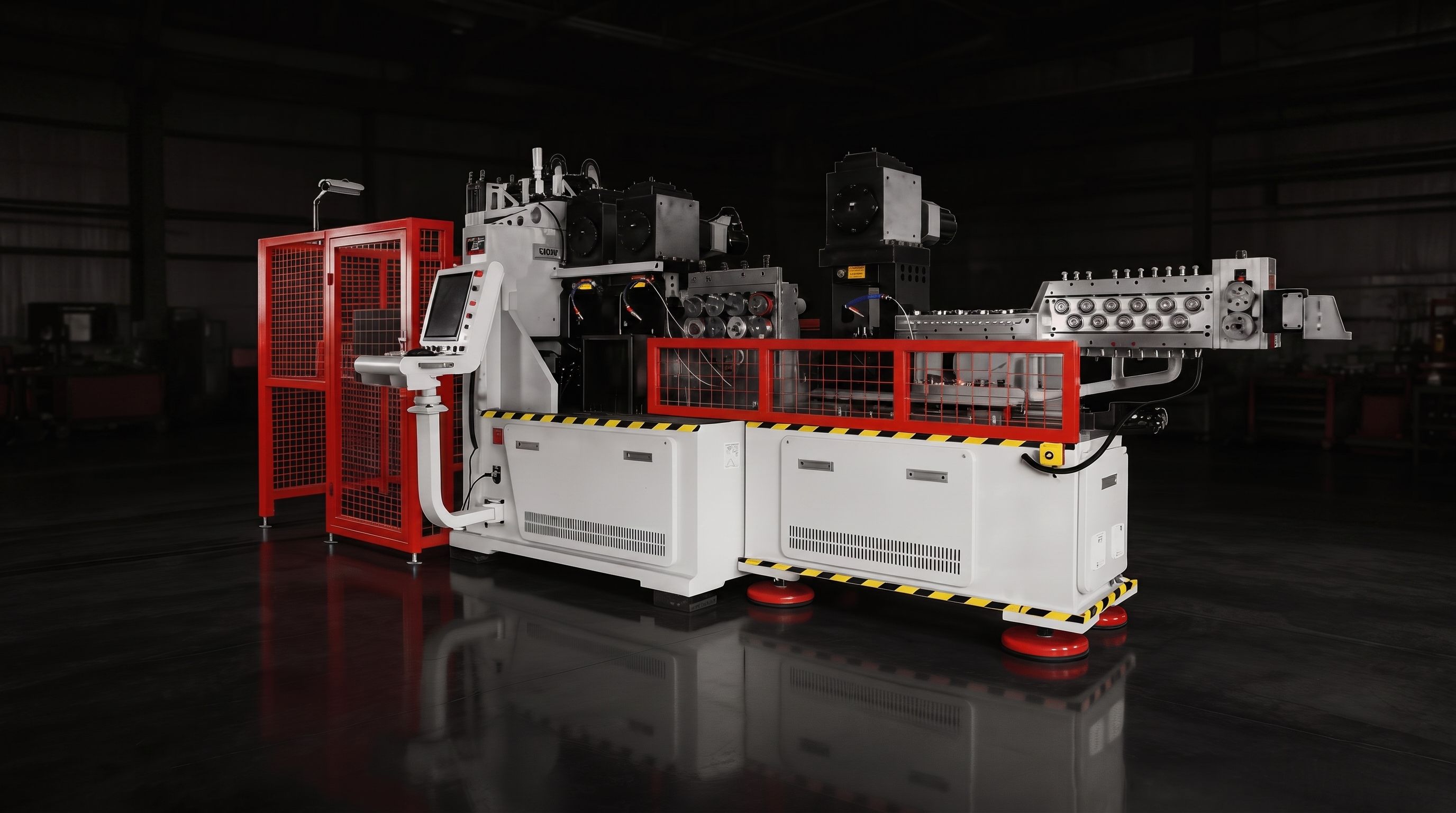
An automatic wire bending machine is a CNC-controlled forming machine that performs the complete forming sequence without manual intervention: wire feeding, positioning, bending, rotating or forming, cutting and finished product output. Instead of an operator controlling each movement, the machine's multi-axis CNC control coordinates servo-driven axes according to a stored program, so the same program produces the same part on every cycle.
The automation is built from four capabilities. CNC control stores and executes forming sequences and coordinates every axis. Servo motors provide accurate, repeatable motion for feeding, bending and rotation. Automatic wire feeding draws material from the coil without operator attention. And multi-axis movement allows bends in multiple planes, enabling complex three-dimensional wire geometries. The operator's role shifts from forming parts to loading programs, monitoring quality and changing coils. For a closer look at multi-axis 3D forming, see our article on the advantages of 3D wire bending machines.
Automatic Wire Bending vs. Manual Wire Forming: Key Differences
The table below compares the two approaches across the factors that matter most in production. Neither column is universally better; the appropriate choice depends on the product and the production context.
| Factor | Manual Wire Forming | Automatic CNC Wire Bending |
|---|---|---|
| Labor requirement | Higher | Lower |
| Positioning | Manual | CNC controlled |
| Repeatability | Operator dependent | Programmable |
| Production volume | Better for low volume | Better for mass production |
| Complex geometry | More difficult | Multi-axis capable |
| Process consistency | Variable | More consistent |
| Changeover | Manual adjustment | CNC program and tooling adjustment |
| Production monitoring | Mainly operator based | CNC-controlled process |
The pattern is consistent: manual forming trades speed and consistency for low investment and flexibility, while automatic wire bending trades higher investment for repeatability, throughput and complex-geometry capability. The decision is a production economics question, not a technology preference.
5 Ways Automatic Wire Bending Improves Mass Production
For manufacturers producing wire components in medium to high volumes, automation changes the economics of each part. The five benefits below are the reasons most automotive, hardware and appliance suppliers make the switch.
1. Reduces Repetitive Manual Operations
In a manual process, every bend is a physical task: measure, position, bend, check, adjust. In an automatic process, feeding, positioning, bending and cutting are executed by the machine, and the operator supervises rather than performs each movement. Automation does not eliminate labor entirely; operators still load programs, change coils, manage tooling and inspect parts. What changes is the nature of the work: repetitive physical tasks are replaced by supervision and process control, reducing fatigue and the errors it introduces.
2. Improves Production Consistency
CNC control holds forming parameters constant across the entire run. Feeding position, bending angle, forming sequence and product dimensions are defined numerically in the program, so the first and last parts of a shift follow the same motion profile. Manual processes accumulate small variations: an operator positions the wire slightly differently or applies slightly different force, and the difference appears in the finished dimensions. On an automatic machine, variation shifts from operator skill to mechanical repeatability, which is far more predictable.
3. Supports Higher Production Efficiency
Efficiency comes from several sources: automated processing runs the forming cycle continuously, reduced handling moves parts from coil to finished product without intermediate steps, fewer manual adjustments shorten the time between cycles, and continuous production capability keeps the machine running through coils with minimal operator attention. Throughput is governed by the machine cycle rather than by operator speed. Exact improvement figures depend on the part and the current process, so manufacturers should measure their own cycle times rather than rely on generic claims.
4. Handles More Complex Wire Geometries
Multi-axis CNC control coordinates feeding, bending, rotation, cutting and other forming operations in a single program, which is what makes three-dimensional wire components practical to produce. A part with bends in several planes, such as a seat suspension wire or a wiper linkage arm, must be rotated between bends so each bend is made in the correct plane. Doing that consistently by hand is difficult because the operator must reposition the part precisely for every plane change. The machine performs the same rotation automatically, and tooling is set up once.
5. Makes Production More Repeatable
Repeatability matters most for B2B manufacturers supplying components into larger production systems. OEMs and Tier 1 or Tier 2 suppliers run their own lines at fixed takt times and expect delivered components to match the approved sample within tolerance, batch after batch. A programmable process supports this in a way a manual process cannot: the same program can be reloaded to reproduce the part, parameters are documented for quality audits, and variation between shifts is minimized. For suppliers that must demonstrate process control, repeatability is itself a qualification advantage.
When Should Manufacturers Switch from Manual to Automatic Wire Bending?
There is no universal threshold where automation becomes mandatory, but automatic equipment deserves serious evaluation when production volume is increasing, the same products are manufactured repeatedly, product dimensions must remain consistent, labor requirements are becoming difficult to manage, components require multiple bending operations, production needs programmable CNC control, and capacity must scale. These conditions are common in automotive supply chains, where volumes grow with customer programs and quality requirements tighten.
Manual forming may remain the right choice when production volume is very low, products are prototypes, product geometry changes constantly, and the investment cannot yet be justified by the workload. Many manufacturers run a mix: automatic machines carry the repeatable high-volume parts, while a manual workbench handles samples, prototypes and short-run specials. The decision should be made product by product, not as an all-or-nothing choice.
Automatic Wire Bending Applications in Automotive Manufacturing
Automotive manufacturing is one of the clearest examples of automatic wire bending applied at production scale. Seat systems, wiper mechanisms and vehicle structures contain dozens of formed wire components, each produced in large volumes with tight tolerances. The applications below are supported by Belan's actual product information and show how machine configuration follows the component; more context is available on the automotive parts wire forming solution page.
Automotive Seat Frame Wire
Seat frames and seat support structures are long, symmetrical wire assemblies: rear seat wire frames, front seat frames and the support structures that give seats their shape and strength. These parts must be dimensionally identical on the left and right sides. Belan forms them with the dual-head BL-2T-15600, which bends both ends of a long workpiece in one synchronized cycle, keeping the two sides consistent and shortening the cycle compared with forming each end separately.
Foam Seat Support Wire
Foam seat support wires and similar small-diameter suspension components are produced on the 6-axis BL-3D-6250, designed for small-diameter wire processing. The same machine class is also used for fuel tank float rods, another precision small wire component requiring accurate multi-plane bends. These parts are small but geometrically demanding, which is exactly where multi-axis CNC control justifies automation over manual forming.
Automotive Wiper Linkage Arms
Wiper linkage arms are produced on the BL-YG-12A wiper linkage arm forming machine, a 12-axis CNC machine that integrates feeding, bending, punching, cutting and twisting or forming operations. A wiper linkage arm is not a pure bending product: it combines bends with punched features and twisted sections in one component. Doing all of these operations on one machine avoids the handling and re-fixturing that a multi-step manual process would require.
Automotive Wire Mesh Components
Automotive wire mesh components, such as the grid structures used inside seat frames, require a different production approach. The BL-WG-2030S automatic wire mesh forming machine handles W-shaped steel wire and plastic-wrapped steel wire, with automatic feeding, grid forming, cutting and finished product output integrated into one machine. It is a specialized example of the same principle: automation replaces repetitive manual assembly with a continuous forming process, as documented in the automotive seat grid plate bending case study.
What Does Automatic Wire Bending Cost?
Equipment investment depends on machine configuration, and configuration is driven by the application. The main cost factors are the number of CNC axes, the wire diameter range, material type, product complexity, required forming operations, automation level such as automatic feeders and part collection, tooling, auxiliary equipment, and the production capacity the machine must deliver.
Because these factors interact, comparing purchase prices alone is misleading. A compact 2D machine for brackets costs less than a dual-head machine for long automotive frames, but they serve different products. Define the total production requirement first, including volumes, growth, parts and tolerances, then compare machines that can actually produce those parts. A machine that matches the application is the economic one.
How to Evaluate the ROI of an Automatic Wire Bending Machine
A realistic business case starts with the manufacturer's own production data rather than generic return-on-investment claims. Inputs include current labor requirements, production volume now and projected over the equipment's life, scrap and rework rates, labor spent on manual handling, current cycle time, the cost of inconsistencies, future demand, and expected machine utilization.
Once collected, the comparison becomes concrete: labor and rework costs avoided, additional output, and consistency improvements are weighed against the investment, tooling and floor space. Because every factory has different labor costs, volumes and quality requirements, the business case must be run on your own numbers. Suppliers such as Belan can help match the machine, but the decision should rest on your actual production data.
How to Choose the Right Automatic Wire Bending Machine
Selecting the right machine requires documenting the part and the process before comparing models. The checklist below is standard in wire bending equipment evaluation.
- Wire diameter. Match the machine's soft and hard wire ranges to the largest and smallest diameter you produce. Running at the edge of a published range invites forming problems.
- Wire material. Soft wire, hard wire, stainless steel, coated and plastic-wrapped wires behave differently during feeding and bending. Confirm the machine and tooling suit your material.
- Product geometry. Flat parts suit 2D machines; parts with bends in several planes require multi-axis 3D capability. Count the planes before comparing machines.
- Number of CNC axes. Define the forming operations your parts need and select the axis configuration that covers them, no more and no less.
- Required production volume. Medium and high volumes justify automatic feeding and continuous cycles; very low volumes may not.
- Feeding and bending accuracy. Feeding accuracy locates bend positions along the wire; bending accuracy determines angles. Specify the tolerances your parts demand.
- Automation requirements. Decide whether the line must run with minimal supervision, which drives requirements for automatic feeders, part collection and monitoring.
- Tooling and changeover requirements. Consider how often products change, how quickly tooling and programs can be swapped, and the supplier's support for application-specific tooling.
The guiding principle is that the machine should be selected according to the actual component and production process, rather than simply choosing the machine with the highest number of axes. Extra axes add capability but also cost; the correct configuration matches the required forming operations with a sensible margin.
Belan's Automatic CNC Wire Bending Solutions
Belan's automatic wire bending machine range covers the main scenarios described in this guide, from compact 2D forming to small-diameter 3D bending and dual-head forming of long components. The machines below show how configuration follows the application.
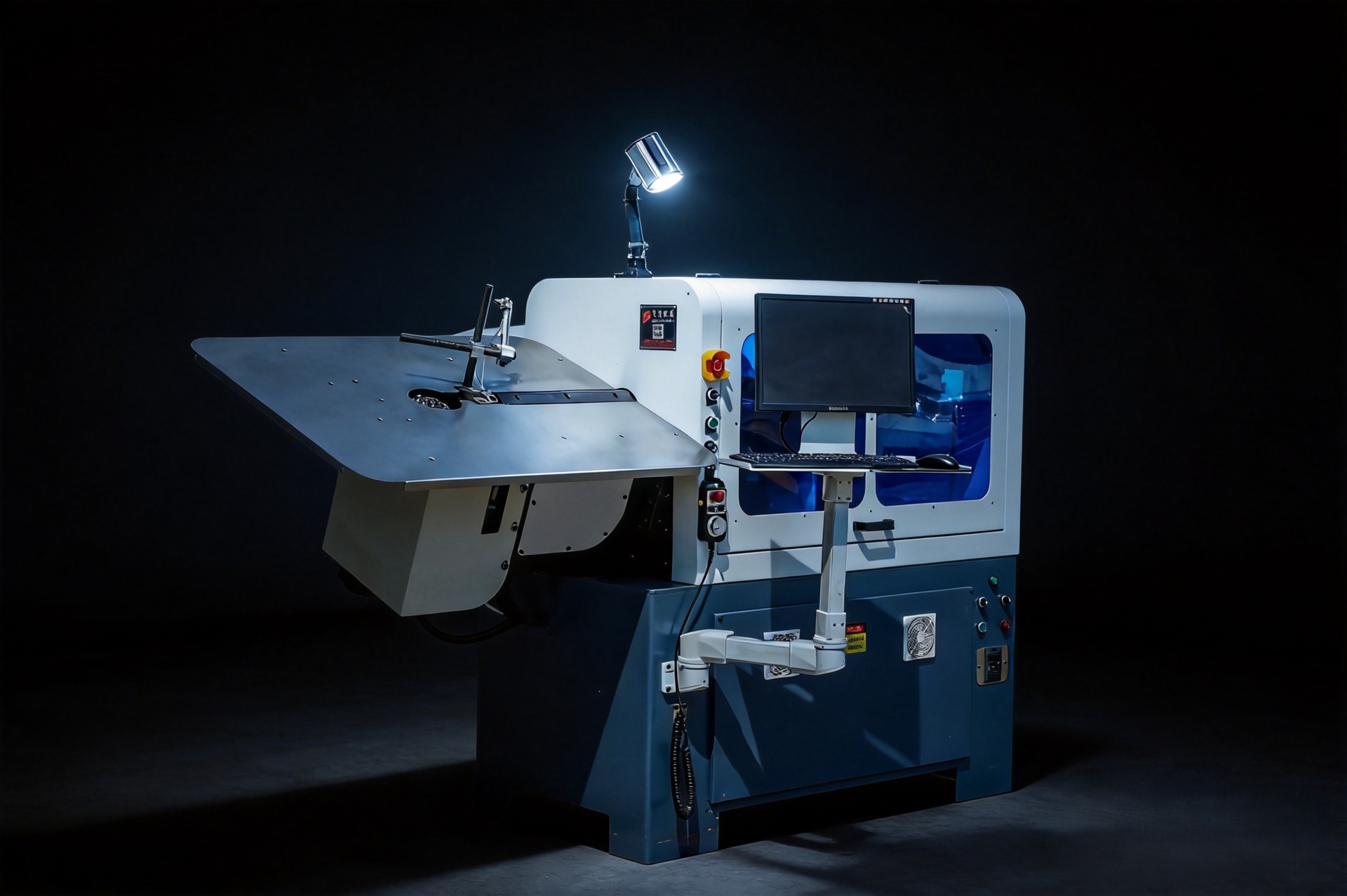
The BL-2D-3800 is a 3-axis 2D CNC wire bending machine for planar wire components. It processes soft wire from Φ3.0 to 8.0 mm and hard wire from Φ3.0 to 6.0 mm, with wire feeding speeds up to 90 m/min and ±0.1 mm feeding accuracy, powered by a 6.5 kW system and equipped with an automatic wire feeder. For brackets, clips, furniture hardware and other 2D parts in medium to high volumes, it is a direct replacement for manual forming with higher throughput and consistency.
The BL-3D-6250 6-axis CNC wire bending machine is designed for small-diameter wire processing: soft wire from Φ1.6 to 3.5 mm and hard wire from Φ1.6 to 2.5 mm, with a 580 mm bending stroke and 5.6 kW total power. Its multi-axis control performs complex three-dimensional bends while maintaining dimensional consistency, making it a practical choice for foam seat support wires, fuel tank float rods and other precision small wire components.
The BL-2T-15600 is a 15-axis dual-head CNC wire bending machine for long and symmetrical workpieces. It processes soft wire from Φ3.0 to 6.0 mm and hard wire from Φ3.0 to 4.5 mm, with a maximum processing length of 2000 mm and 26.9 kW total power. The two synchronized heads form both ends of a component in a single cycle, keeping both sides dimensionally identical and shortening cycle time for rear seat wire frames and similar long automotive components.
Is Automatic Wire Bending Right for Your Production?
An automatic CNC wire bending machine is worth evaluating if your production matches several of the conditions below:
- You produce wire components repeatedly, not as one-off pieces.
- You have medium- to high-volume orders that justify dedicated forming equipment.
- Your customers require consistent dimensions from batch to batch.
- You want to reduce repetitive manual operations and the variation they introduce.
- You produce complex wire geometries with bends in multiple planes.
- You need flexible CNC programming to handle product changes quickly.
- You plan to increase production capacity in the coming years.
The right decision depends on the product geometry, wire specifications, production volume, and required automation level. Manufacturers that answer yes to most of these points should request a machine evaluation with part drawings and production data, and compare configurations on their own numbers.
Conclusion
Manual wire forming can remain useful for prototypes and low-volume production, and no manufacturer should abandon it where it is genuinely the right tool. But when production becomes repeatable, volumes grow and consistency matters, an automatic wire bending machine delivers what a manual process cannot sustain: repeatability, efficiency, reduced manual operations, complex forming capability and scalability. The comparison is not about which method is absolutely better; it is about which one matches your product geometry, wire specifications, production volume and automation needs.
Get an Automatic CNC Wire Bending Solution
BELAN Machinery, a professional provider of automotive wire forming solutions.
If you are evaluating automatic wire bending, start by documenting your wire specifications and production requirements, then contact Belan to discuss them and receive a suitable automatic CNC wire bending solution matched to your application.
Contact Belan for a Customized Wire Forming SolutionFrequently Asked Questions
Is an automatic wire bending machine better than manual wire forming?
Automatic equipment is generally more suitable for repetitive, medium- to high-volume production, where consistent dimensions and continuous cycles matter most. Manual forming can still be practical for prototypes, low-volume work and products whose geometry changes frequently. The better choice depends on your volume, product repeatability and quality requirements rather than a blanket rule.
What are the main advantages of automatic wire bending machines?
The main advantages are automation of feeding, positioning, bending and cutting; repeatable programmable forming from the first part to the last; reduced manual operations and operator-dependent variation; higher production efficiency through continuous cycles; and CNC-controlled forming of complex multi-plane geometries that are difficult to produce by hand.
Can automatic wire bending machines be used for automotive components?
Yes. CNC wire bending machines are used for various automotive wire components, including seat frames, rear seat wire structures, foam seat support wires, wiper linkage arms and other supported applications. Belan machines cover seat frame wire with dual-head forming, small-diameter support wires with 6-axis machines, and wiper linkage arms with an integrated 12-axis forming process.
How much does an automatic wire bending machine cost?
There is no single price, because cost depends on machine configuration, number of CNC axes, wire specifications, automation level, tooling and production requirements. Manufacturers should evaluate the total production requirement, including volumes, parts and tolerances, and compare machines that can actually produce those parts rather than comparing purchase prices alone.
How do I know if my production is ready for wire bending automation?
Evaluate production volume, product repeatability, labor requirements, product complexity, quality requirements and future production demand. If the same parts are produced repeatedly in medium to high volumes, dimensions must stay consistent, and manual operations are becoming a bottleneck, your production is a strong candidate for automatic wire bending.
Can Belan customize an automatic wire bending solution?
Yes. Belan can recommend machine configurations and forming solutions based on your wire specifications, product drawings, production requirements and application needs. Sharing drawings and production data helps match the correct machine class, axis configuration and tooling before you commit to an investment.