

Introduction
Every production manager who has ever signed off on a CNC wire bending machine purchase knows the stakes. Pick the right machine and you get years of stable output, tight tolerances, and a clear return on investment. Pick the wrong one and you inherit a cascade of problems: parts that fail dimensional inspection at the customer's receiving dock, cycle times that make your cost-per-part uncompetitive, and a machine that sits idle half the shift because it cannot handle the next job that came in.
The root cause of most bad purchases is not budget. It is mismatch. A machine bought for its maximum wire diameter that rarely processes anything above 4 mm. A 2D bender tasked with producing 3D geometries that require rotary-head articulation. A single-head machine struggling to meet weekly volumes that a dual-head configuration would handle in three days. This guide is written for the engineer or purchasing manager who wants to avoid those mistakes. Every recommendation is tied to real machine specifications and actual manufacturing scenarios so you can map your requirements directly to the right equipment.
Understand Your Wire Material
Wire material is the first variable to lock down because it determines the forces your machine will experience with every bend cycle. Different materials behave differently under the same bending radius, and a machine sized for mild steel wire will struggle or fail with spring steel of the same diameter.
Carbon Steel (Low-Carbon / Mild Steel)
The most common wire in industrial forming. It bends predictably, has moderate springback, and places standard demands on tooling and servo torque. Most general-purpose CNC wire bending machines are designed around carbon steel in the 2.0 to 8.0 mm range. If your material mix is predominantly low-carbon steel, focus your machine selection on the wire diameter table in the next section.
Stainless Steel
Stainless steel requires roughly 30 to 50 percent more bending force than carbon steel of the same diameter. It also exhibits greater springback, meaning your CNC compensation parameters need to be more aggressive. Machines with higher-axis-count servo control, such as the BL-3D-5600 5-axis model, handle the increased torque demands of stainless within the 2.5 to 4.0 mm hard-wire range reliably. For stainless wire above 6.0 mm, step up to the BL-3D-5800 or BL-3D-6800 with their higher-power servo architecture.
Spring Steel
Spring steel wire combines high tensile strength with aggressive springback. It demands a rigid machine frame and servo motors with sufficient overhead torque. Undersized machines will show progressive angle drift across a production run as thermal buildup shifts calibration. Match your machine to the wire's hard-wire specification rating, not just its nominal diameter. The BL-3D-5800 and BL-3D-51200 are both rated for hard-wire processing and include high-torque servo drives designed for sustained output.
Galvanized Steel
Galvanized wire behaves mechanically similar to the base steel substrate, but the zinc coating introduces two considerations: coating adhesion during tight-radius bends and surface finish requirements. If your product requires pristine surface quality post-forming, opt for machines with polished or coated bending tools and feed rollers that minimize surface marking.
Copper and Aluminum
Both are soft, ductile, and require much less forming force than steel. The primary challenge is not torque but surface protection, particularly for copper used in electrical busbar and conductor applications where scratches can create hot spots. Machines with nylon-lined or polished feed paths are advisable. The BL-TP-45-6E 13-axis busbar processing machine is purpose-built for copper and aluminum bar forming with surface-protective tooling.
Flat Wire
Flat wire introduces an additional degree of difficulty: cross-sectional orientation. Unlike round wire, which is radially symmetric, flat wire must maintain its edge orientation through each bend or the finished part will be geometrically wrong. Standard rotary-head machines can handle simple flat-wire shapes, but dedicated flat-wire rotary bending machines such as the BL-3D-8600 8-axis model are designed with a flat-plate rotary head that preserves orientation and prevents twist throughout the bending sequence.
Choose the Right Machine Based on Wire Diameter
Wire diameter is the single most objective filter for machine selection. Every CNC wire bending machine has a rated processing range defined by the mechanical limits of its feed rollers, straightening system, bending head, and servo drive torque. Operating consistently at or near the maximum of that range accelerates wear on consumable tooling; operating far below it means you have paid for capacity you do not use.
A practical rule: if 80 percent of your production volume falls within the middle 60 percent of a machine's rated diameter range, that machine is a good fit. The table below maps common wire diameter ranges to specific Belan models.
| Wire Diameter Range | Recommended Belan Model | Axes | Typical Applications |
|---|---|---|---|
| 1.6 to 3.5 mm | BL-3D-6250 | 6-Axis | Electronic components, small hardware, precision clips, springs |
| 2.5 to 6.0 mm | BL-3D-5600 | 5-Axis | Automotive seat frames, furniture hardware, appliance brackets |
| 3.0 to 8.0 mm | BL-3D-5800 / BL-3D-6800 | 5 / 6-Axis | Industrial shelving, construction hardware, furniture components |
| 5.0 to 12.0 mm | BL-3D-51200 / BL-3D-61200 | 5 / 6-Axis | Large-diameter structural components, agricultural equipment parts, machinery brackets |
| 5.0 to 14.0 mm | BL-3D-51400 | 5-Axis | Construction reinforcement, large-diameter industrial frames |
| 8.0 to 16.0 mm | BL-3D-51600 / BL-3D-61600 | 5 / 6-Axis | Infrastructure components, high-strength wire forming for max-diameter requirements |
Selecting a machine whose rated range comfortably spans your actual wire diameters rather than just covering the extremes will improve machine utilization, reduce tooling costs from premature wear, and give you operational headroom when production requirements shift. A manufacturer processing primarily 3 to 5 mm wire on a machine rated for 1.6 to 3.5 mm will experience constant servo overload alarms. The same manufacturer on a 5 to 16 mm machine will see poor feed accuracy on small diameters because the feed roller geometry is optimized for larger cross-sections.
Select the Right Machine for Your Product Complexity
Wire product complexity directly determines which machine architecture you need. A CNC wire bending machine that excels at simple 2D shapes will struggle with multi-plane 3D geometries, and a high-axis-count 3D machine would be an unnecessary investment for predominantly flat parts. Understanding the four main bending technologies helps you match the machine to the product, not the other way around.
2D Wire Bending Machine
A 2D wire bending machine produces parts where all bends lie in a single plane. Think wire shelf frames, simple hooks, rectangular basket handles, and flat linkage components. These machines typically use 3-axis control with a bending head that moves in X-Y while rotating the wire plane. They are simpler to program, faster in cycle time for flat geometries, and cost significantly less than multi-axis systems. The BL-2D-3800 delivers high-speed planar bending at up to 90 m/min wire feed, making it ideal for manufacturers producing flat-profile components in medium to high volumes. Typical industries include wire shelving, display rack manufacturing, and simple automotive brackets.
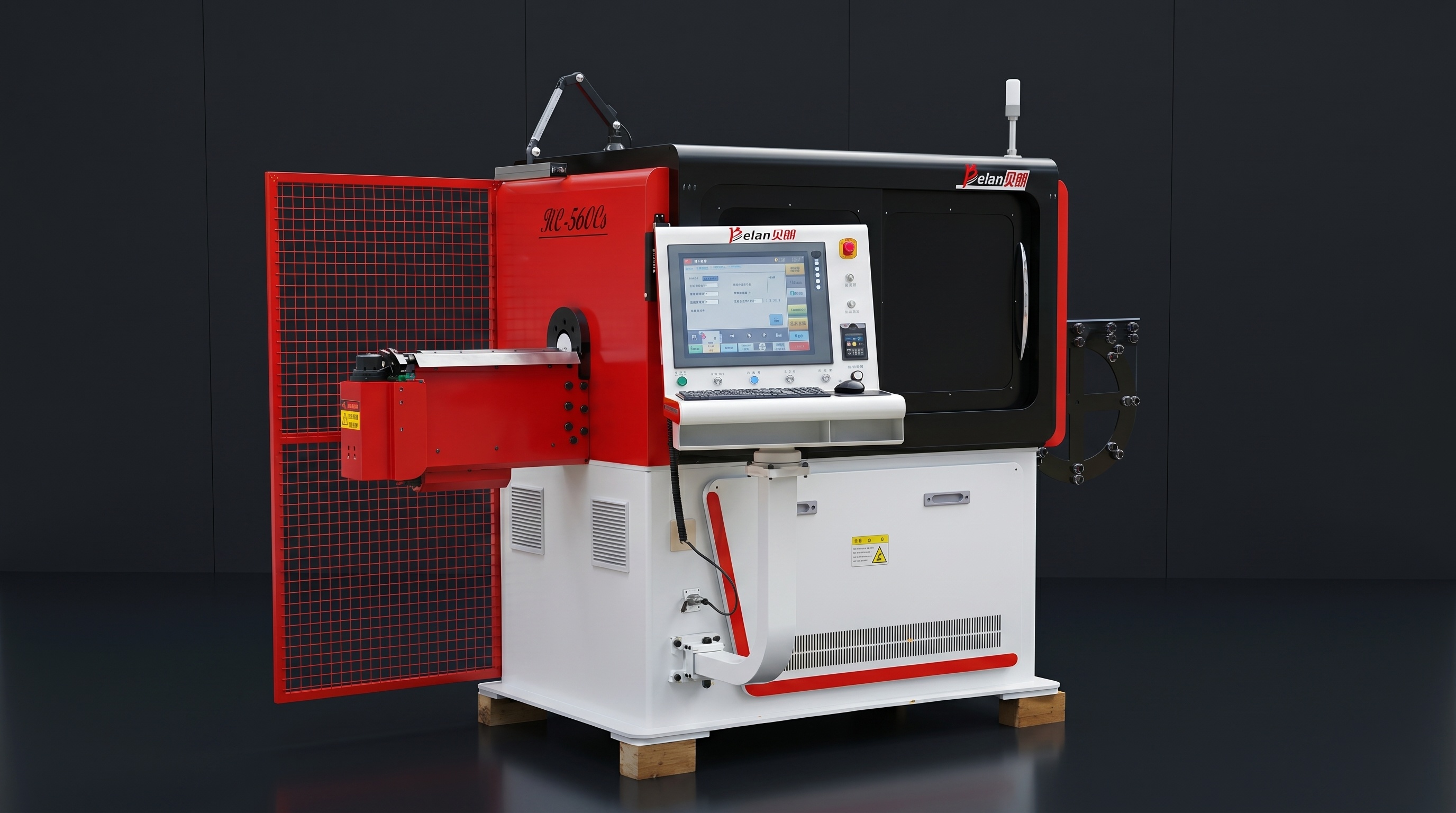
Rotary-Head CNC Wire Bending Machine
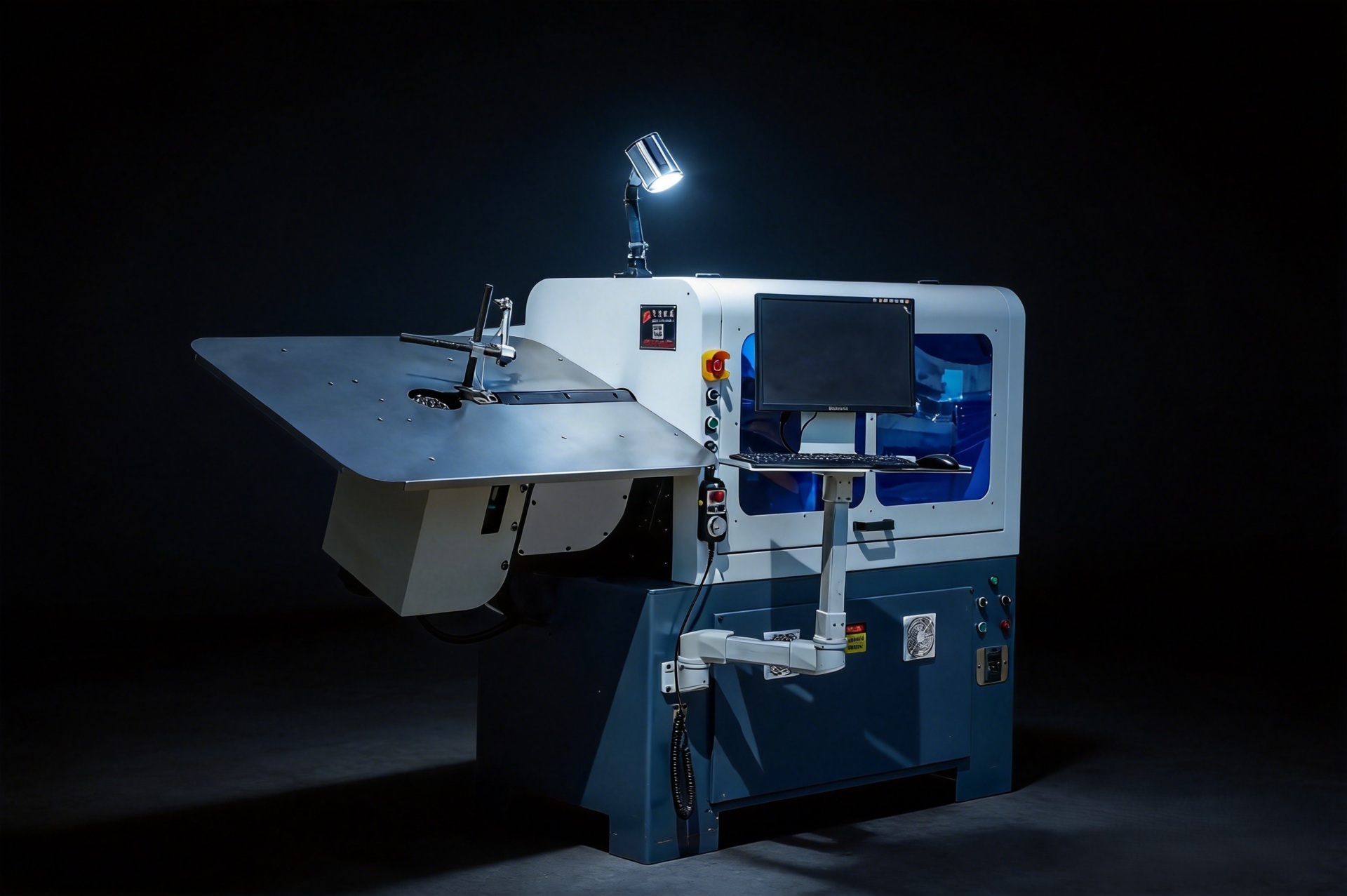
When products require bends in multiple planes, a rotary-head machine is the standard solution. The bending head rotates to approach the wire from any angle, enabling true 3D forming without repositioning the workpiece. These machines produce automotive seat frames, suspension spring assemblies, complex furniture frames, and appliance wire racks with dozens of bends across three spatial axes. Belan's rotary-head portfolio ranges from the BL-3D-5600 (5-axis, 2.5 to 6.0 mm) to the BL-3D-61600 (6-axis, 8.0 to 16.0 mm), covering virtually every wire diameter and complexity level a manufacturer is likely to encounter. The key differentiator between models is the servo torque available for the bending head and the physical size of the rotary unit, which determines the maximum bend radius achievable.
Double-Head Wire Bending Machine
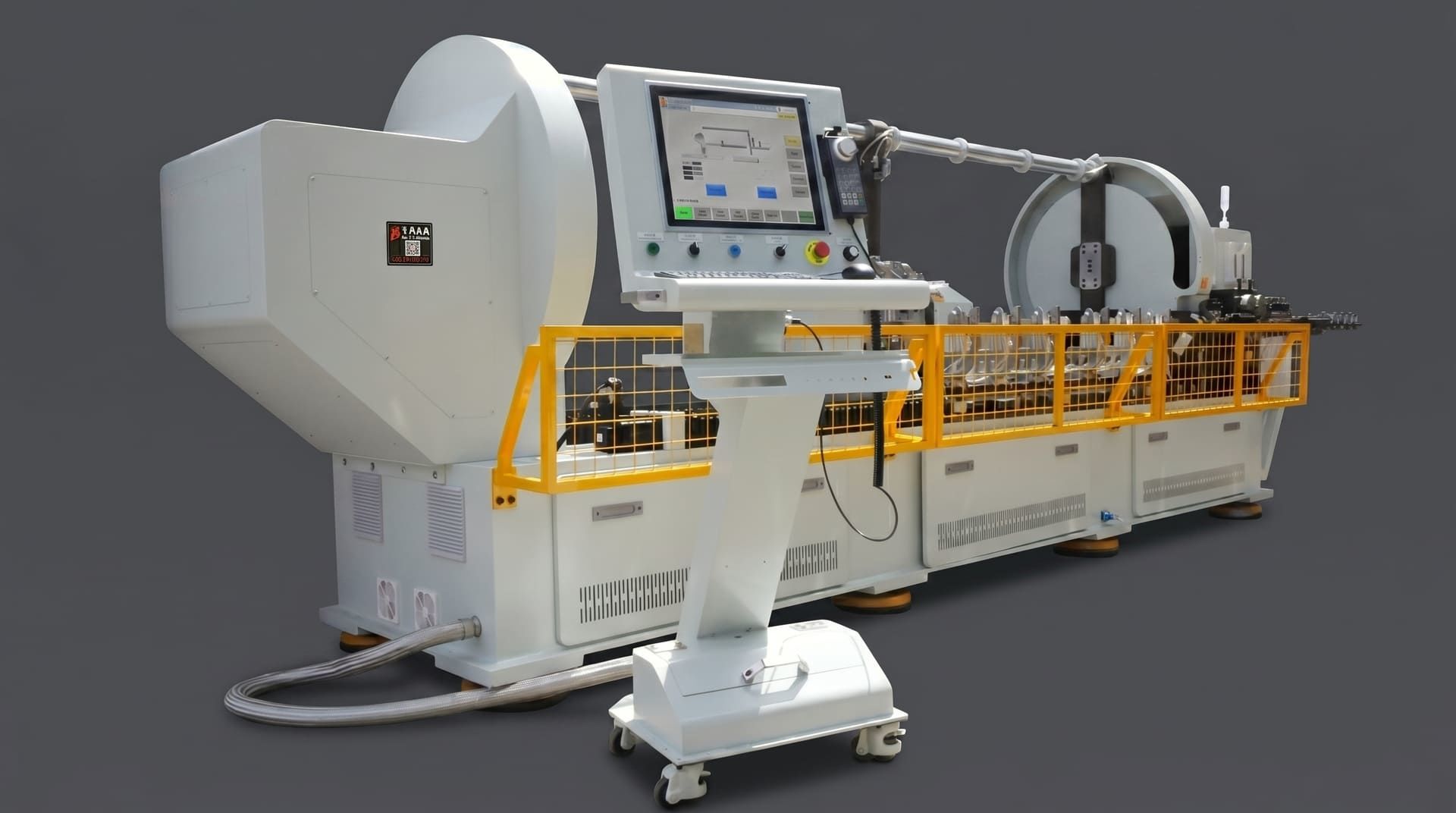
A double-head machine puts two independently controlled bending heads on a single frame, both operating simultaneously. This architecture doubles throughput for symmetric or two-ended parts and is the go-to solution for grid and mesh products where both ends of a wire segment need identical or complementary forming. The BL-2T-15600 with 15 axes across dual parallel heads is purpose-built for woven grid products such as oven racks, refrigerator shelves, wire mesh panels, and display grids. If your product line includes any form of wire grid or mesh, a double-head configuration can reduce per-part cycle time by 40 to 60 percent compared to processing the same part on a single-head machine with repositioning steps.
Flat Wire Rotary Bending Machine
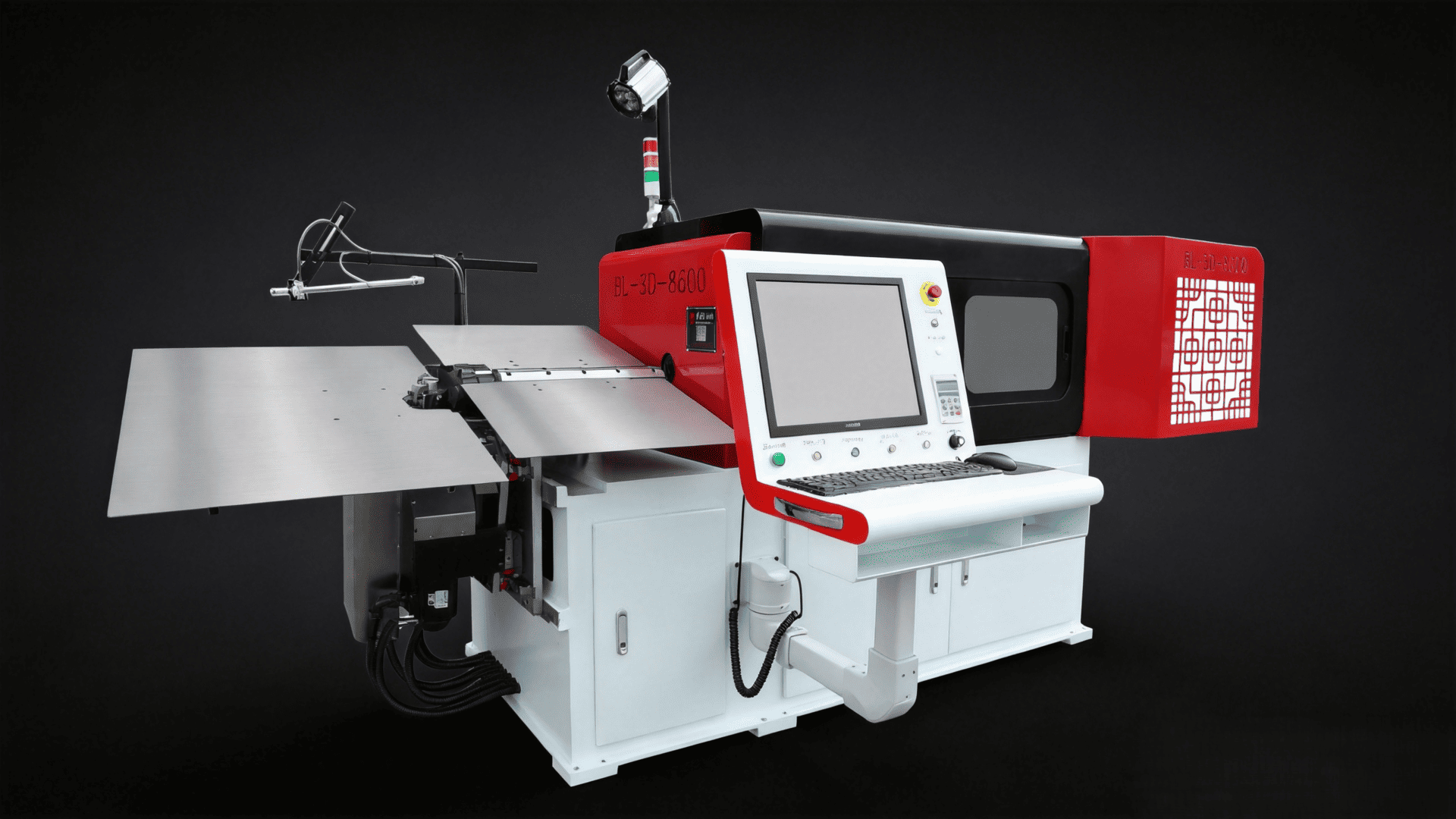
Flat wire products present a unique challenge: the wire's rectangular cross-section must maintain a consistent edge orientation throughout multi-bend sequences or the part will twist and fail dimensional inspection. A flat wire rotary bending machine uses a flat-plate rotary head and a shaped guide channel that prevents the wire from rotating around its longitudinal axis during bending. The BL-3D-8600 8-axis model processes flat wire from 2.0 to 6.0 mm in thickness and is widely used for furniture leg frames, architectural metal components, decorative hardware, and structural brackets where the flat cross-section is a design requirement.
Consider Production Volume and Automation
Machine selection runs on two parallel tracks: capability and capacity. A machine that can technically form your part is only half the equation. You also need to verify that it can do so at the rate your production schedule demands, without operator intervention bottlenecks.
Prototype and Low-Volume Production
If you are producing samples, custom one-off components, or runs of under 1,000 parts per month, the priority should be changeover speed and programming flexibility rather than raw throughput. A machine like the BL-3D-5600 with its 5-axis configuration and intuitive teach-in programming allows an operator to switch from one part geometry to another in under 15 minutes. Look for machines with stored program memory that can recall previous job parameters without re-parameterizing from scratch.
Medium-Batch Production
At 5,000 to 50,000 parts per month, cycle time and machine uptime become the dominant cost drivers. A 6-axis machine like the BL-3D-6800 offers an additional bending axis that can reduce repositioning movements and shave 10 to 20 percent off cycle times compared to a 5-axis configuration on complex parts. At this volume, even a 1.5-second reduction in per-part cycle time translates to roughly 12 additional hours of productive capacity per month, enough to absorb a new small-batch order without adding a shift.
High-Volume Continuous Production
Above 50,000 parts per month, automation accessories become as important as the machine itself. Automatic wire decoiling and straightening systems eliminate the 3 to 5 minutes per coil of manual spool changes. For grid and mesh products, the BL-2T-15600 dual-head architecture effectively doubles throughput without doubling floor space. In high-volume environments, the return on investment for automation is typically realized within 12 to 18 months through labor reduction alone, before accounting for the consistency improvement that automated feeding delivers.
Production Flexibility
If your production mix changes monthly or seasonally, invest in a machine with excess capacity rather than one sized exactly to today's largest part. The BL-3D-51200, rated for 5.0 to 12.0 mm, gives you the headroom to take on larger-diameter orders without purchasing a second machine. The incremental cost of that extra capacity is typically 15 to 25 percent of the base machine price, far less than the cost of a second unit when demand materializes.
Evaluate Precision and CNC Control
Precision in CNC wire bending is measured across four dimensions: wire feeding accuracy, bending angle accuracy, repeatability across a production run, and geometric consistency from part to part. These are not abstract specifications. They directly determine your scrap rate, your customer's incoming inspection pass rate, and whether you can run lights-out production.
Multi-Axis CNC Control
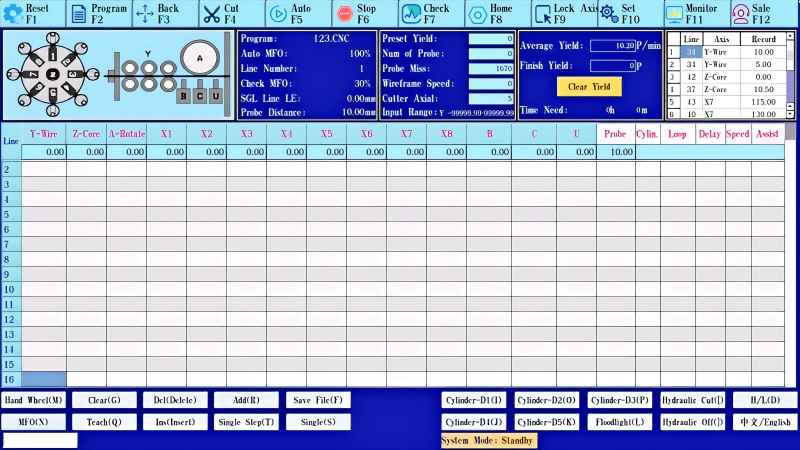
Each axis in a CNC wire bending machine is driven by an independent servo motor under closed-loop control. A 5-axis machine controls wire feed, wire rotation, bending head rotation, bending head lift, and bending angle. A 6-axis configuration adds an additional degree of freedom, typically a secondary bending head movement or an independent cutoff axis, which reduces the number of repositioning moves and improves cycle time. The difference between 5-axis and 6-axis is most noticeable on parts with more than 15 bend features per piece, where the extra axis eliminates multiple non-value-added movements.
Servo System Quality
Not all servo systems are equal. The Belan BL-3D series uses digital AC servo drives that maintain position accuracy within encoder resolution even under varying load conditions. On the BL-3D-5600, this translates to feeding accuracy of 300 mm plus or minus 0.1 mm and bending angle accuracy of 90 degrees plus or minus 0.2 degrees in sustained production. These figures are achieved through real-time servo feedback loops that compensate for temperature drift and mechanical wear across an 8-hour shift.
Repeatability and Production Consistency
A machine that holds plus or minus 0.1 mm on part one and plus or minus 0.5 mm on part 10,000 will generate a scrap mountain. Repeatability depends on the rigidity of the machine frame, the quality of the linear guides and ball screws in each axis, and the thermal stability of the servo drives. A robust machine structure with properly sized castings and precision-ground guide rails will hold its geometric relationships over years of production. When evaluating a machine, ask to see Cpk data from a production run of at least 500 consecutive parts, not just a first-article inspection report.
Questions to Ask Before Buying a CNC Wire Bending Machine
These questions are designed to surface the requirements that actually drive machine specification. Work through them with your production team before contacting suppliers.
1. What wire material or materials will you process?
This determines servo torque requirements and whether you need hardened or coated tooling. A single-material shop has simpler requirements than one switching between mild steel, stainless, and spring steel on the same machine.
2. What is your actual wire diameter range?
Not the range you might need someday, but the range of 80 percent of your current orders. Base the machine purchase on that 80 percent and treat the occasional outlier as a subcontracted exception rather than a machine-sizing driver.
3. What is the most complex product geometry you produce?
Count the bends, identify multi-plane features, and note any tight-radius requirements. This determines whether you need a 2D machine, a standard rotary-head machine, or a flat-wire-specific configuration.
4. What is your monthly production volume per part number?
Map this against the cycle time of your target machine. A machine with a 12-second cycle time producing a part you need at 100,000 units per month will run 333 hours, requiring at least two shifts and leaving no margin for setup or maintenance.
5. Do you need production flexibility for future product lines?
If your business grows by adding new parts rather than increasing volume of existing parts, bias toward a machine with a wider diameter range and more axes. The capacity margin will pay for itself the first time you quote a new job without buying additional equipment.
6. What is your tolerance stack-up across the finished assembly?
If your bent wire part is one component in a welded or assembled structure, the forming tolerance needs to be tighter than the assembly tolerance by at least a factor of two. A 0.5 mm forming tolerance on a part going into a 1.0 mm assembly tolerance leaves zero room for fixture variation.
Why Manufacturers Choose Belan
Belan Automation has built its reputation on a focused approach: CNC wire bending machines designed and manufactured to serve real production environments, not trade-show demonstrations. The Belan portfolio spans 24 models across seven product lines, covering wire diameters from 1.6 mm to 16.0 mm and axis counts from 3 to 15. This breadth means you are not forced to compromise between a machine slightly too small and one unnecessarily large. You can choose the exact configuration your parts require.
Every Belan machine is built on a rigid frame structure with precision-ground guide rails and digital AC servo drives. The multi-axis CNC control architecture supports complex multi-bend programs with real-time parameter adjustment, and the programming interface is designed for shop-floor use, requiring no specialized CAD training. Belan also provides custom engineering for non-standard applications, including specialized tooling, modified feed systems, and integrated automation cells. For manufacturers expanding into new product categories, this engineering support can shorten the path from part print to first production article by weeks.
Technical support extends beyond installation. Belan's application engineers work with customers to optimize bend sequences, reduce cycle times, and troubleshoot material-related forming issues. This ongoing support is particularly valuable for manufacturers processing challenging materials such as high-tensile spring steel or large-diameter stainless steel wire, where small parameter adjustments can yield significant quality improvements.
Conclusion
Selecting a CNC wire bending machine is a decision that echoes through your production floor for years. The right machine aligns with your wire material, your typical diameter range, your part complexity, your volume requirements, and your precision expectations, all without forcing compromises in any single dimension. The process starts by defining those requirements clearly: what wire, what diameter, what shape, how many, and how accurately. From there, the machine selection narrows to a manageable set of candidates that match your actual production profile.
Belan's application engineering team can review your part drawings and production requirements to recommend the most suitable machine configuration and provide a detailed technical proposal. Whether you need a single machine for a new product line or a complete forming cell with automated material handling, a specification-driven recommendation ensures the equipment matches the work.
Get a Machine Recommendation for Your Products
BELAN Machinery, a professional provider of automotive wire forming solutions.
Send your part drawings, wire specifications, and production volume targets to Belan for a no-obligation technical review. Our application engineers will recommend the most suitable machine configuration and provide a detailed specification sheet and quotation.
Contact Belan for Machine Selection AdviceFrequently Asked Questions
What is the difference between a 2D and 3D CNC wire bending machine?
A 2D machine produces parts with all bends in a single plane using 3-axis control, ideal for flat profiles like wire shelf frames and simple hooks. A 3D rotary-head machine adds a rotating bending head that approaches the wire from any angle, enabling multi-plane geometries required for automotive seat frames, complex furniture frames, and appliance wire components. The choice depends entirely on whether your product designs include out-of-plane bends.
How do I determine the right wire diameter capacity for a CNC bending machine?
Identify the wire diameter that covers 80 percent of your current production volume and select a machine whose rated range spans that diameter comfortably, ideally with the diameter falling in the middle 60 percent of the machine's range. Operating near the maximum rating accelerates tooling wear and reduces servo margin. Operating far below the rated range sacrifices feed accuracy because the straightening and feed roller geometry is designed for larger cross-sections.
Can one CNC wire bending machine handle multiple wire materials?
Yes, most industrial CNC wire bending machines can process carbon steel, stainless steel, galvanized steel, and non-ferrous wires like copper and aluminum. However, the machine must be sized for the most demanding material in your mix, typically stainless or spring steel, which requires 30 to 50 percent more bending force than carbon steel at the same diameter. Changing materials may also require tooling adjustments to accommodate different springback characteristics.
What is the typical lead time for a CNC wire bending machine?
Standard-configuration machines from Belan typically ship within 30 to 45 days of order confirmation. Machines requiring custom tooling, specialized feed systems, or integrated automation may require 60 to 90 days depending on engineering scope. Installation and commissioning generally add 5 to 10 working days on site. For accurate lead time on a specific configuration, contact Belan with your machine model and customization requirements.
How much operator training is required for a CNC wire bending machine?
Operators familiar with basic CNC concepts can typically learn machine operation, program loading, and basic parameter adjustment within three to five working days. Programming new part geometries from scratch requires additional training, usually one to two weeks depending on part complexity. Belan provides on-site training during commissioning and remote technical support afterward. The teach-in programming interface is designed for shop-floor use without requiring CAD software experience.
Is it better to buy a single versatile machine or multiple dedicated machines?
This depends on your production profile. If you run high volumes of a small number of part families, dedicated machines optimized for each family will deliver the lowest cost per part. If your mix changes frequently or you produce a wide variety of geometries, a versatile machine like the BL-3D-6800 with a broad diameter range and 6-axis control gives you the flexibility to handle multiple product types without changeover bottlenecks or idle capacity on specialized equipment.