

When evaluating CNC wire bending machines for industrial production, one of the first technical decisions engineers face is axis configuration. The difference between a 5-axis and 6-axis CNC wire bending machine goes beyond a single added motor—it fundamentally changes the range of geometries you can produce, the efficiency of your workflow, and the complexity of parts you can deliver to your customers.
At Dongguan Belan Automation Equipment Co., Ltd., both 5-axis and 6-axis rotary-head wire bending machines form the backbone of a product line engineered for precision manufacturing. With over 50 R&D engineers and technology integration from Germany and Japan, Belan designs each series to address distinct production requirements. This article provides a technical breakdown of the two configurations, their application domains, and a direct model comparison to help you make an informed purchasing decision.
Understanding CNC Axes in Wire Bending
In a CNC wire bending machine, each axis corresponds to an independently controlled servo-driven motion. A standard configuration includes the following fundamental axes:
- Wire Feed (Y-axis): Controls the linear advancement of wire into the bending head. Precision here directly determines part dimensional accuracy.
- Bend Arm Rotation: Rotates the bending tool around the wire to create angles. This is the primary forming motion.
- Cutting Axis: Drives the cutting blade to separate the finished part from the wire coil.
- Bend Head Lift (Z-axis): Raises or lowers the bending head to switch between bending planes for 3D parts.
- Rotary Head Rotation (C-axis): Rotates the entire bending head assembly, enabling bends in different spatial planes without repositioning the wire.
These five axes are sufficient for a wide range of 2D and basic 3D wire forms. However, certain geometries require an additional degree of freedom—and that is where the 6th axis enters the picture.
The Core Technical Difference: What the 6th Axis Provides
The defining distinction between 5-axis and 6-axis CNC wire bending machines at Belan is the independent internal rotation motor—also referred to as the inner mandrel axis.
On a 6-axis machine such as the Belan BL-3D-6800, the 6th axis is powered by a dedicated 1.0KW servo motor that rotates the wire around its own longitudinal axis during the bending process. This capability delivers three critical forming advantages that a 5-axis configuration cannot replicate:
- Multi-directional complex bending in a single setup: The inner mandrel rotation allows the wire to be oriented at any angle relative to the bending tool without requiring the entire rotary head to reposition. This eliminates tool interference in tight-corner geometries.
- Continuous spiral and helical forming: Parts requiring helical coils, torsion springs, or spiral geometries can be produced in one continuous operation. A 5-axis machine would need multiple setups or secondary operations for the same result.
- Reduced secondary positioning: Because the wire itself rotates, the machine can approach the same bend point from different angles without releasing and re-clamping the workpiece—preserving dimensional accuracy across complex part programs.
In practical terms, the 6th axis transforms the machine from a sequential bending device into a true spatial forming system. Operations that require the wire to be actively manipulated in three rotational degrees of freedom—rather than simply bent in sequence—are only possible with this additional axis.
To understand why this matters in production, consider a typical automotive seat frame component. On a 5-axis machine, the rotary head rotates to orient the bending tool for each bend plane. When a bend requires a particularly awkward approach angle—such as an inward-facing clip on a seat backrest wire—the rotary head may face physical clearance limitations. The 6-axis machine circumvents this entirely: the mandrel rotates the wire to present the optimal approach angle to a stationary bending tool, eliminating geometric interference.
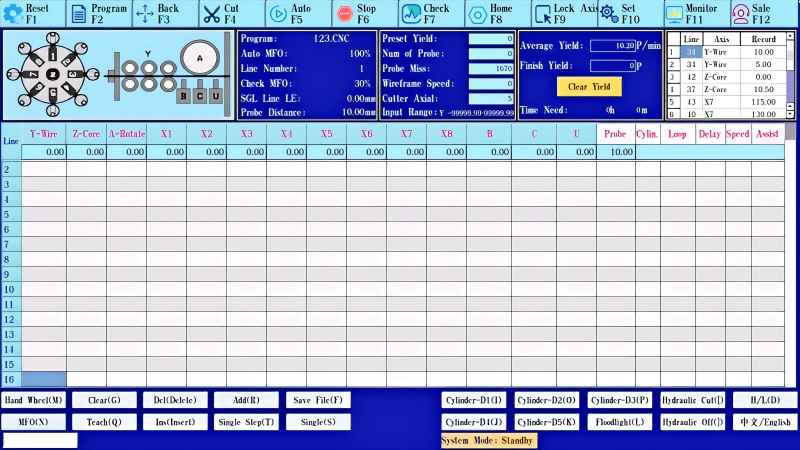
It is also worth noting that the additional axis does not increase programming complexity proportionally. Belan's CNC controller handles multi-axis coordination internally, so the operator defines the desired part geometry and the system automatically generates the coordinated axis movements. The learning curve from 5-axis to 6-axis operation is typically addressed within the standard on-site training period provided with machine installation.
Application Comparison: 5-Axis vs 6-Axis
The choice between axis configurations is ultimately dictated by the parts you produce. Below is a practical classification based on verified Belan application data and production experience.
5-Axis CNC Wire Bending Machine
Typical products: 2D and basic 3D wire forms where all bends lie in predictable planar or near-planar orientations. From Belan's BL-3D-5600 and BL-3D-5800 application samples, verified examples include:
- Car seat frames (3.0mm steel wire)
- Motorcycle dashboard brackets (5.0mm wire)
- Hardware display pendants and hooks
- Kitchen and bathroom hardware components
- Garden tool wire parts
- Supermarket shelf brackets and display hooks
Typical industries: General hardware manufacturing, furniture, kitchenware, garden tools, supermarket shelving, and light automotive components.
6-Axis CNC Wire Bending Machine
Typical products: Complex 3D geometries requiring multi-directional bending, parts with tight-radius compound curves, and components where wire rotation during forming is essential. From Belan's BL-3D-6800 and BL-3D-6250 application samples:
- Automotive seat wire frames with multi-angle support brackets
- Seat backrest wire assemblies with integrated clips and positioning tabs
- Complex 3D wire components for motorcycle sub-assemblies
- Heavy-gauge furniture structural wire parts
- Industrial equipment wire guards and protective cages
- Office equipment wire frames with tight-radius bends
Typical industries: Automotive tier-1 and tier-2 suppliers, motorcycle manufacturing, heavy-duty furniture production, industrial equipment, and precision hardware where dimensional consistency across high-volume runs is critical.
Machine Comparison: BL-3D-5600 vs BL-3D-6800
Belan offers multiple models in both the 5-axis and 6-axis series, each optimized for different wire diameter ranges and production volumes. For a representative comparison, we examine the BL-3D-5600 (entry-tier 5-axis) and the BL-3D-6800 (mid-to-heavy-duty 6-axis)—two widely adopted configurations that illustrate the practical differences between the platforms.
| Specification | BL-3D-5600 (5-Axis) | BL-3D-6800 (6-Axis) |
|---|---|---|
| Number of Axes | 5 | 6 (with independent inner mandrel motor) |
| Wire Diameter (Soft) | Φ2.5 – 6.0 mm | Φ3.0 – 8.0 mm |
| Wire Diameter (Hard) | Φ2.5 – 4.0 mm | Φ3.0 – 6.0 mm |
| Total Power | 7.8 KW | 12.2 KW |
| Machine Weight | 1,800 KG | 3,000 KG |
| Feeding Motor | Standard | 4.5 KW high-power |
| Max Feeding Speed | Standard | 90 M/min |
| Automatic Feeder | Standard | 1,500 KG large-load |
| Inner Mandrel Motor | Not available | 1.0 KW independent servo |
| Feeding Accuracy | 300 mm ±0.1 mm | 300 mm ±0.1 mm |
| Angle Accuracy | 90° ±0.2° | 90° ±0.2° |
| Typical Applications | Small-to-medium hardware, automotive seat frames, kitchenware, garden tools | Heavy-duty automotive, furniture structural parts, industrial equipment, complex 3D wire forms |
Both machines share the same precision specifications—300mm ±0.1mm feeding accuracy and 90° ±0.2° angle accuracy—which reflects Belan's commitment to consistent quality across the product range. The key difference lies not in how accurately each machine bends, but in what geometries each can produce in a single automated cycle.
For smaller-scale or lighter-duty requirements, Belan also offers the BL-3D-6250—a compact 6-axis machine designed for small-diameter wires (soft Φ1.6–3.5mm, hard Φ1.6–2.5mm) with a lightweight 1,200KG frame and energy-efficient 5.6KW power configuration. Meanwhile, customers needing 5-axis capability for larger-diameter wires can consider the BL-3D-5800 (soft Φ3.0–8.0mm) or the heavy-duty BL-3D-51200 (up to Φ12.0mm soft wire).
Production Advantages of 6-Axis Over 5-Axis
Beyond the obvious geometric capability advantage, the 6-axis configuration delivers measurable production benefits in real manufacturing environments:
- Fewer forming steps per part: The inner mandrel rotation eliminates the need to stop, re-orient, and re-engage the wire for multi-angle bends. A part that requires 12 sequential operations on a 5-axis machine may complete in 8 on a 6-axis—directly reducing cycle time.
- Less manual adjustment between batches: When switching between part programs with different spatial orientations, the 6th axis adapts programmatically rather than requiring mechanical tooling changes. This shortens changeover time, particularly in high-mix production environments.
- Reduced secondary positioning: For parts where the same bend point must be approached from multiple angles, a 6-axis machine maintains continuous wire control. A 5-axis machine would need to release, reposition, and re-clamp—introducing potential for cumulative tolerance drift.
- Higher dimensional accuracy on complex parts: By keeping the wire under active servo control through all spatial rotations, the 6-axis configuration preserves the 300mm ±0.1mm feeding accuracy across compound bend sequences. Tolerance stacking across multiple setups is eliminated.
- Faster production speed for 3D geometries: The BL-3D-6800's 4.5KW feeding motor delivers up to 90 M/min wire feed speed, combined with continuous inner mandrel rotation. For parts with 8+ bend points in different planes, this can reduce per-part cycle time by 20–35% compared to equivalent 5-axis processing.
- Better batch-to-batch consistency: Automated mandrel rotation removes operator-dependent manual adjustments from the process. Every part in a production run follows the identical servo-controlled toolpath, resulting in tighter statistical process control.
Additional advantages of Belan's 6-axis platform include the heavy-duty 3,000KG frame on the BL-3D-6800, which suppresses vibration during high-speed forming, and the 1,500KG large-load automatic feeder that supports extended unattended production runs. The machine's servo-driven architecture also contributes to energy efficiency—motors draw power only during active forming motions rather than running continuously. For manufacturers operating multiple shifts, this translates to measurable reductions in per-part energy cost.
Programming and changeover efficiency represents another practical advantage. On the 6-axis platform, once a part program is validated, the servo-driven mandrel rotation is stored as programmatic data. When the same part is produced again months later, there is no need to re-establish mechanical settings—the machine recalls the exact toolpath from memory. This repeatability is particularly valuable in contract manufacturing environments where production batches for the same customer recur at irregular intervals.
Technology integration across Belan's rotary-head series ensures that operating principles, maintenance procedures, and programming interfaces remain consistent between 5-axis and 6-axis models. Manufacturers who start with a BL-3D-5600 and later add a BL-3D-6800 to their production line benefit from a unified operator training experience and interchangeable tooling where applicable.
Purchasing Recommendations: When to Choose Each
Choose a 5-Axis Machine When:
- Your parts are predominantly 2D or simple 3D: If bends fall within predictable planar orientations and do not require wire rotation during forming, a 5-axis machine such as the BL-3D-5600 delivers full capability without the added cost of the 6th axis.
- Budget is a primary constraint: The 5-axis platform offers a lower initial investment while still providing 300mm ±0.1mm precision. For startups or manufacturers expanding into wire bending for the first time, it represents an accessible entry point.
- You produce general wire products: Standard hardware components, retail display fixtures, kitchenware handles, garden tool parts, and supermarket shelf brackets are all well within the 5-axis capability envelope.
- Workshop space is limited: The BL-3D-5600's compact 3,000×1,900×1,900mm footprint and 1,800KG weight make it suitable for facilities where floor space is at a premium.
- Energy consumption matters: At 7.8KW total power, the 5-axis configuration has lower operating costs, making it cost-effective for high-volume production of simpler parts.
Choose a 6-Axis Machine When:
- Your parts require complex 3D geometries: If your product catalog includes automotive seat frames with integrated clips, multi-angle brackets, or components where bends must be approached from non-standard orientations, the BL-3D-6800's inner mandrel capability is essential.
- Production efficiency is critical: The 4.5KW feeding motor with 90 M/min speed and the elimination of secondary positioning steps translate directly to higher throughput on complex parts. For tier-1 automotive suppliers operating on JIT delivery schedules, this efficiency advantage is non-negotiable.
- You serve automotive or precision industries: Automotive OEMs and tier-1 suppliers consistently demand the dimensional consistency and process capability that 6-axis servo control provides. The BL-3D-6250 and BL-3D-6800 are purpose-built for these environments.
- You anticipate part complexity growth: If your business is expanding from simple hardware into more sophisticated assemblies, investing in 6-axis capability upfront future-proofs your production line against evolving customer requirements.
- Heavy-gauge wire forming is required: The BL-3D-6800's 12.2KW total power and 3,000KG rigid frame handle hard wire up to Φ6.0mm and soft wire up to Φ8.0mm with consistent precision, making it suitable for structural components.
Verified Industry Applications
Belan's CNC wire bending machines serve a diverse range of global manufacturing sectors. Based on verified product sample data from the Belan website, the following applications represent real production scenarios:
| Industry | Typical Components | Recommended Configuration |
|---|---|---|
| Automotive | Seat frames, backrest wire assemblies, positioning clips, dashboard brackets, wiper linkage arms | 5-Axis or 6-Axis (depending on complexity) |
| Motorcycle | Dashboard brackets, frame sub-components, luggage rack wire forms | 5-Axis (BL-3D-5600/5800) |
| Furniture | Chair frames, table support structures, decorative wire elements, sofa spring assemblies | 6-Axis for structural parts; 5-Axis for decorative |
| Kitchen & Bathroom | Hardware pendants, towel racks, shelf brackets, organizer wire frames | 5-Axis (BL-3D-5600) |
| Garden Tools | Tool handles, support frames, trellis wire components | 5-Axis |
| Supermarket Shelving | Display hooks, shelf brackets, price tag holders, basket frames | 5-Axis |
| Office Equipment | Chair armatures, desk support frames, filing system wire components | 6-Axis (BL-3D-6800) |
| Industrial Equipment | Wire guards, protective cages, heavy-duty brackets, machinery frames | 6-Axis heavy-duty or 5-Axis (BL-3D-51200) |
Frequently Asked Questions
Can a 5-axis machine be upgraded to 6-axis later?
No. The 6th axis requires an independent internal rotation motor, additional servo drive channels, and a structurally different bending head assembly. These are integrated at the manufacturing stage and cannot be retrofitted. If you anticipate needing 6-axis capability in the future, it is more cost-effective to purchase a 6-axis machine initially.
Is programming more difficult on a 6-axis machine?
Modern CNC controllers on Belan machines feature intuitive parametric programming interfaces. While the 6-axis configuration adds one more degree of freedom to program, the control system handles multi-axis coordination automatically. Operators familiar with 5-axis programming typically adapt to 6-axis within the training period provided during installation.
What is the typical ROI difference between 5-axis and 6-axis?
For manufacturers producing complex 3D parts, the 6-axis machine's reduction in cycle time, elimination of secondary operations, and lower scrap rates from improved consistency typically result in a faster payback period despite the higher initial investment. For simple 2D/3D parts, the 5-axis configuration offers the better ROI as the 6th axis capability would remain underutilized.
Does Belan offer both configurations with the same precision?
Yes. Both the 5-axis BL-3D-5600 and 6-axis BL-3D-6800 achieve 300mm ±0.1mm feeding accuracy and 90° ±0.2° angle accuracy. Belan maintains consistent precision specifications across both platforms, so the choice should be based on geometric requirements rather than accuracy concerns.
What wire materials are compatible with both configurations?
Both 5-axis and 6-axis Belan machines process mild steel, stainless steel, and other common wire materials within their respective diameter ranges. The BL-3D-5600 handles soft wire up to Φ6.0mm and hard wire up to Φ4.0mm, while the BL-3D-6800 extends to soft Φ8.0mm and hard Φ6.0mm. For extra-large diameter requirements, Belan's BL-3D-61600 rotary-head machine accommodates soft wire up to Φ16.0mm. Material compatibility should be discussed during the consultation phase to ensure the recommended machine configuration matches your specific wire specifications.
How do I determine which configuration my parts need?
The most reliable approach is to submit your part drawings or sample components to Belan's engineering team for a feasibility assessment. Their 50+ R&D engineers can evaluate the required bend sequences, identify whether the 6th axis is necessary, and recommend the optimal machine configuration for your specific product portfolio. The evaluation typically covers wire material properties, bend radius requirements, production volume targets, tolerance specifications, and any special features such as coining, chamfering, or marking that may need to be integrated into the forming cycle.
Not Sure Which Configuration Fits Your Production?
BELAN Machinery, a professional provider of automotive wire forming solutions.
Send us your part drawings or samples. Belan's engineering team will evaluate your requirements and recommend the optimal 5-axis or 6-axis CNC wire bending solution—at no cost.
Contact Belan for a Feasibility AssessmentRelated Resources
- How to Choose a CNC Wire Bending Machine: Complete Buying Guide — Covers wire material, diameter, automation level, and precision requirements
- BL-3D-5600 5-Axis CNC Wire Bending Machine — Full specifications and application samples
- BL-3D-6800 6-Axis CNC Wire Bending Machine with Inner Mandrel — Technical details and production capabilities
- BL-3D-6250 6-Axis Small-Diameter Wire Bending Machine — Compact precision solution for fine wire forming