

Introduction
Wire components are fundamental to modern automotive seat systems. From structural seat frames that provide occupant support to suspension wires that deliver comfort and vibration damping, precision-formed wire components determine both the safety performance and the perceived quality of an automotive seat. For automotive seat manufacturers and Tier 1 suppliers, the challenge lies not only in meeting dimensional tolerances but also in achieving these standards at scale, across multiple seat platform designs, with consistent repeatability.
The wire components found in a typical automotive seat assembly include structural seat frames, rear seat wire frames, seat support structures, seat suspension wires (also known as foam seat support wires), and serpentine springs. Each component type presents distinct forming requirements in terms of wire diameter, bend geometry, symmetry, and production volume. A manual or semi-automated production approach often struggles to maintain the dimensional consistency and throughput that automotive OEMs and Tier 1 suppliers demand.
This article examines the common wire components in automotive seat frame manufacturing, the key production challenges suppliers face, how CNC wire bending technology addresses these challenges, and which Belan machine configurations are purpose-built for specific seat wire applications. The objective is to help manufacturing engineers, production managers, and purchasing teams evaluate automated wire forming solutions that align with their component specifications, production volume, and quality requirements.
Common Wire Components in Automotive Seat Manufacturing
Understanding the forming requirements of each wire component is the foundation for selecting the right production equipment. Below is an overview of the key wire components found in automotive seat assemblies and their respective manufacturing considerations.
Automotive Seat Frames
The seat frame is the structural backbone of any automotive seat. It must withstand occupant weight, crash loads, and long-term fatigue cycles while maintaining its geometric integrity. Seat frames are typically formed from medium-to-large diameter steel wire, with the forming process requiring precise control over bend angles, radii, and overall dimensional accuracy.
Dimensional tolerance is especially critical for seat frames because even minor deviations can prevent proper assembly with seat tracks, recliner mechanisms, and mounting brackets. In a production environment, the ability to achieve repeatable forming results — part after part, shift after shift — is what separates a capable automotive wire bending machine from a general-purpose bender. The forming equipment must deliver consistent output across thousands of cycles without requiring frequent recalibration or manual adjustment.
Rear Seat Wire Frames
Rear seat wire frames present a distinct manufacturing challenge due to their elongated, often symmetrical geometry. These components typically extend across the full width of the vehicle interior, with forming lengths that can reach up to 2000mm or more. The long span of these components makes them susceptible to forming asymmetry if the bending process is not properly synchronized at both ends.
The most effective production approach for rear seat wire frames is dual-head synchronized forming, where both ends of the wire component are bent simultaneously under coordinated CNC control. This method not only ensures left-right symmetry but also significantly reduces cycle time compared to sequential single-head bending. For suppliers producing rear seat frames for multiple vehicle platforms, equipment flexibility — the ability to switch between different frame geometries with minimal changeover time — is equally important.
Seat Suspension Wires and Foam Support Wires
Seat suspension wires and foam seat support wires serve as the elastic foundation beneath the seat cushion foam. These components are responsible for distributing occupant weight evenly, absorbing road vibrations, and maintaining seat comfort over the vehicle's service life. Unlike structural seat frames, suspension wires are formed from smaller-diameter wire, typically in the range of Φ1.6-3.5mm for soft wire and Φ1.6-2.5mm for hard wire.
The forming requirements for suspension wires center on consistent bend angles and precise geometric repetition. A seat suspension wire array may contain dozens of identical bends across its length, and any angular variation between these bends can create uneven support pressure — leading to comfort complaints or premature foam wear. Small-diameter wire also demands careful feed control and bending force calibration to prevent wire surface damage or cross-section deformation during forming.
Serpentine Springs and Seat Support Structures
Serpentine springs and auxiliary seat support structures are characterized by their repetitive wave-form bending geometry. These components require the wire forming machine to execute a sequence of alternating bends — left, right, left, right — with precise angular control at every inflection point. A single serpentine spring may involve 20 to 40 individual bends, each of which must match the programmed angle within a narrow tolerance band.
Production consistency is the primary concern for serpentine spring manufacturing. Because these components are produced in high volumes for each seat assembly, any drift in forming accuracy over a production run results in unacceptable part-to-part variation. Automated CNC control with closed-loop servo feedback is essential to maintain the repeatable bend angles and consistent wire feed that high-volume serpentine spring production demands.
Key Challenges in Automotive Seat Wire Manufacturing
Automotive seat wire manufacturing is not simply a matter of bending wire to shape. The combination of tight dimensional specifications, high production volumes, and increasingly varied product portfolios creates a set of interrelated challenges that define the daily reality for automotive seat component suppliers.
Multiple Manufacturing Steps
In a traditional wire component production line, the manufacturing process typically involves five or more discrete steps: wire cutting to length, manual or semi-automated bending, dimensional adjustment, resistance or MIG welding (for assemblies), and final inspection. Each step represents a potential source of variation and a point where production bottlenecks can emerge.
The labor dependency of this multi-step workflow is substantial. Manual bending relies on operator skill and attention, which naturally varies between shifts and individuals. Manual adjustment after bending — often necessary to correct springback or alignment issues — adds cycle time and introduces inconsistency. Moreover, the material handling between each step creates non-value-added time that reduces overall equipment effectiveness (OEE). For suppliers facing pressure to reduce per-unit costs while maintaining quality, the multi-step manual approach becomes increasingly difficult to justify.
An automated CNC wire bending machine for automotive parts consolidates cutting, straightening, bending, and sometimes even secondary operations into a single continuous process. This integrated approach eliminates transfer time between stations, reduces labor requirements, and establishes a controlled forming environment where every process variable — feed rate, bend angle, rotation speed — is governed by servo-driven CNC commands rather than operator judgment.
Maintaining Consistent Dimensions
Dimensional consistency is arguably the most demanding requirement in automotive seat frame manufacturing. Seat components must interface with multiple adjacent parts — rails, recliners, foam cushions, trim panels — each of which has its own tolerance stack. A bend angle deviation of just one or two degrees on a seat frame can cause assembly interference that requires rework or, in worse cases, part rejection.
The root cause of dimensional inconsistency in manual production lies in springback — the natural tendency of wire to partially return to its original shape after bending. Springback varies with wire material properties, diameter, bend radius, and even ambient temperature. Skilled operators learn to compensate for springback through experience, but this compensation is inherently inconsistent. CNC-controlled wire bending machines address springback through programmable over-bend compensation stored in the machine's control system, ensuring that every part receives the same calibrated correction regardless of who is operating the equipment or which shift is running.
Increasing Demand for Flexible Production
Automotive seat suppliers today rarely produce a single seat design in isolation. A typical Tier 1 supplier may manufacture seat frames and wire components for multiple vehicle platforms simultaneously — each with different wire diameters, bend geometries, and production quantities. This product diversity places a premium on production flexibility: the ability to switch between different component configurations quickly without sacrificing quality or throughput.
Traditional dedicated tooling — where each part design requires its own set of mechanical bending dies — makes frequent changeovers expensive and time-consuming. Modern program-controlled CNC wire bending machines store part programs digitally and can switch between configurations in minutes through software commands rather than mechanical re-tooling. This programmability is particularly valuable for automotive seat frame wire forming operations where production runs may alternate between different seat platform components within the same day.
How CNC Wire Bending Technology Improves Automotive Seat Production
The transition from manual or semi-automated production to CNC-controlled wire forming represents a fundamental shift in how automotive seat wire components are manufactured. The improvement is not incremental — it is systemic, affecting every aspect of the production process from material input to finished part output.
Automated Feeding and Forming
Automated wire feeding eliminates the most labor-intensive step in traditional wire component production. A CNC wire bending machine equipped with a servo-driven feeding system draws wire directly from a coil or straightener, advances it to the bending head with programmable precision, and executes the forming sequence without operator intervention. Wire feed accuracy is maintained through encoder feedback, which continuously monitors actual feed length against the programmed value and corrects any deviation in real time.
The practical benefits of automated feeding extend beyond labor savings. Consistent feed rate and feed length directly translate to consistent part dimensions. The elimination of manual wire positioning also removes a common source of handling damage — scratches, dents, or cross-section deformation that can compromise part quality or downstream welding operations.
Multi-Axis CNC Control
Multi-axis CNC control is the enabling technology behind complex 3D wire forming. Unlike 2D bending machines that operate in a single plane, multi-axis machines coordinate the movement of bending arms, rotating heads, and wire feed mechanisms across multiple degrees of freedom simultaneously. A 6-axis machine can bend wire in three-dimensional space — forming angles that vary in both horizontal and vertical planes within a single continuous program — while a 15-axis dual-head configuration adds synchronized double-end forming capability.
For automotive seat frame components — which often feature bends in multiple planes to conform to seat contour and mounting point geometry — multi-axis capability is not optional; it is essential. The ability to program and execute complex 3D forming sequences digitally reduces reliance on specialized mechanical tooling and enables the same machine to produce a diverse range of component geometries.
Integrated Forming Processes
The true efficiency gain of CNC wire forming lies in process integration. Where traditional manufacturing separates feeding, straightening, bending, cutting, and sometimes punching or notching into individual workstations, a modern CNC wire bending machine consolidates these operations into a single automated sequence:
This integrated workflow eliminates transfer time, reduces work-in-process inventory, and creates a controlled production environment where forming parameters are digitally managed from start to finish. For automotive seat suppliers, process integration means shorter lead times, fewer quality inspection points, and a more predictable production schedule — all of which contribute to lower per-part manufacturing cost.
Belan Wire Forming Solutions for Automotive Seat Components
Belan provides a range of automotive wire forming solutions specifically engineered for the diverse requirements of automotive seat wire component manufacturing. The following three machine platforms address the most common seat wire forming applications encountered by Tier 1 and Tier 2 suppliers.
BL-2T-15600 Dual-Head CNC Wire Bending Machine
The BL-2T-15600 is a 15-axis dual-head CNC wire bending machine purpose-built for high-efficiency double-end forming of long and symmetrical wire components. With independent dual-head servo control and a maximum processing length of 2000mm, this machine is the primary solution for producing automotive rear seat wire frames, front seat frames, seat suspension wires, double serpentine springs, automotive linkage rods, and seat support structures.
Key technical specifications include a wire diameter range of hard wire Φ3.0-4.5mm and soft wire Φ3.0-6.0mm, total installed power of 26.9KW, and a minimum center distance of 80/120mm between the dual forming heads. The 15-axis configuration — comprising feed, straightening, dual bending arms, dual rotation axes, dual lifting axes, and cutting — enables simultaneous bending at both ends of the wire component, effectively doubling throughput for symmetrical parts compared to single-head sequential forming.
The machine's industrial-grade design incorporates internationally recognized components: Yitu servo motors and CNC control system, Tai Cheng precision reducers, NSK/IKO/FAG bearings, Schneider electrics, Hiwin guide rails and lead screws, and Mean Well power supply units. With a robust 5000KG machine structure, the BL-2T-15600 is engineered for continuous production environments where uptime and long-term stability are critical performance metrics.
For suppliers manufacturing rear seat wire frames where left-right forming symmetry and high throughput are essential, the BL-2T-15600's dual-head synchronized operation provides a significant efficiency advantage over single-head alternatives. For more details, refer to our dedicated article on the Double-Head Wire Bending Machine and its applications in automotive seat wire production.
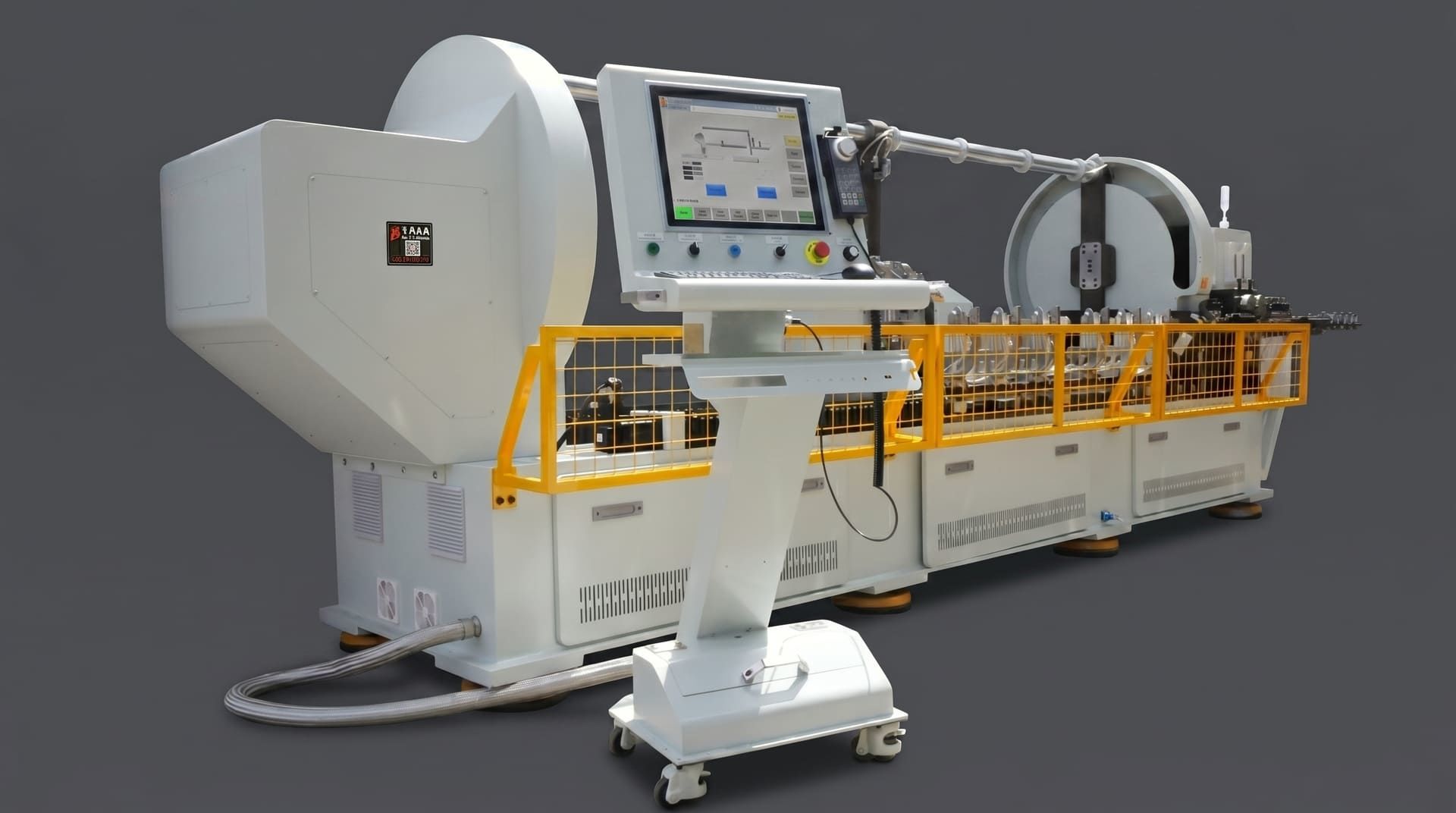
BL-WG-2030S Automotive Wire Mesh Forming Machine
The BL-WG-2030S is a fully automatic automotive wire mesh forming machine developed for high-efficiency production of automotive seat frame wire mesh and welded wire seat assemblies. It processes W-shaped steel wire at Φ2.0mm and plastic-coated steel wire at Φ3.0mm, with a forming system comprising 28-34 servo-controlled axes and 30KW total installed power.
What distinguishes the BL-WG-2030S is its fully integrated production process: automatic wire feeding, grid forming, precision cutting, and finished product collection all occur within a single continuous workflow. The machine handles grid dimensions up to 3000×2000mm with spacing adjustable from 50mm to 300mm, achieving forming accuracy of ±0.5mm. Production output reaches 15m² per hour, or approximately 120m² per 8-hour shift, making this machine suitable for large-scale automotive seat frame mesh production.
The 6000KG machine structure ensures stable operation during the high-speed forming cycle, and the 200KG-capacity automatic feeding rack supports continuous uninterrupted production. For more information on this machine and its technical capabilities, visit the Automotive Wire Mesh Forming Machine product page.
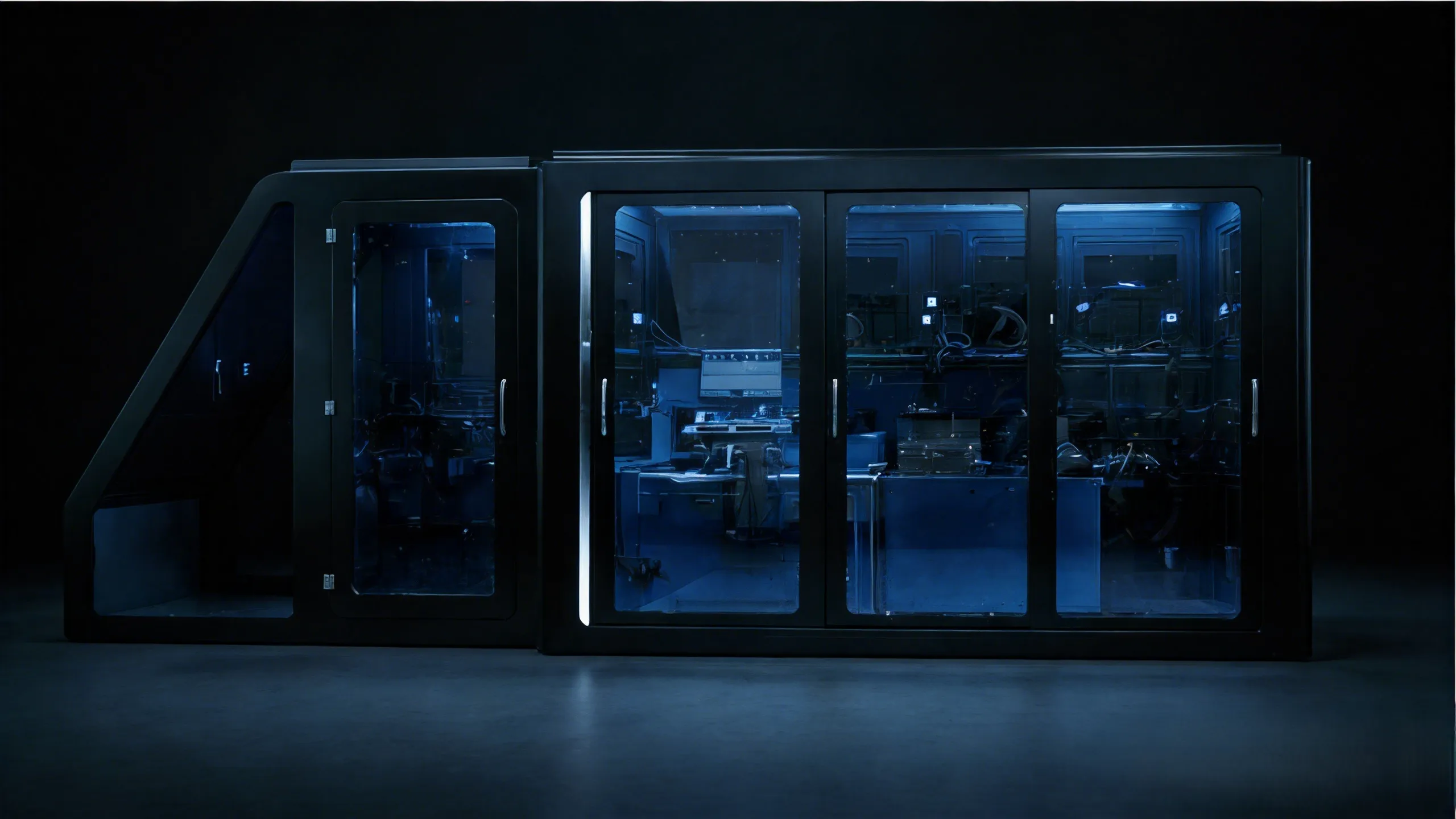
BL-3D-6250 Small-Diameter CNC Wire Bending Machine
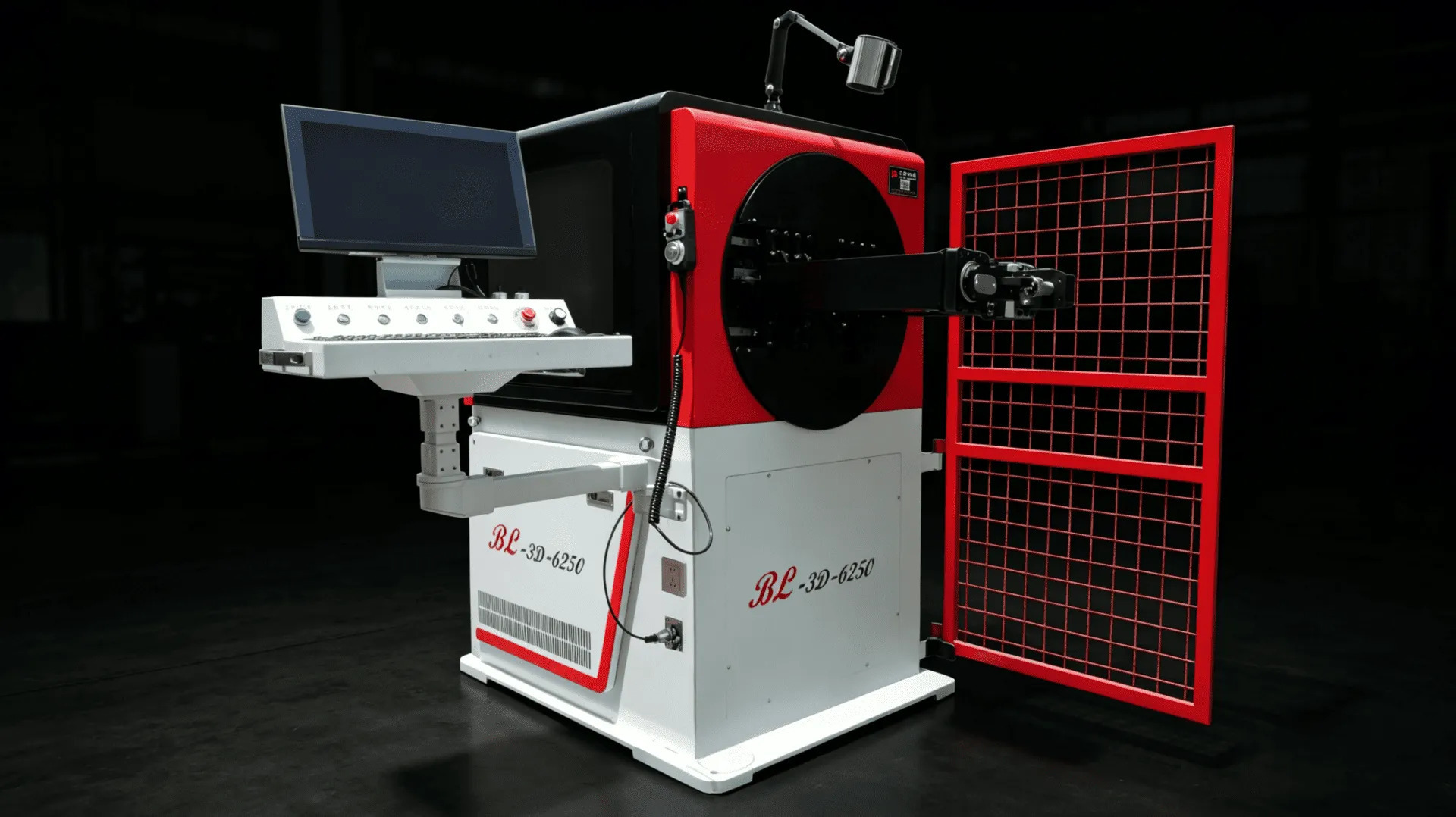
The BL-3D-6250 is a 6-axis CNC wire bending machine specifically developed for small-diameter wire processing in automotive seat frame wire forming applications. Designed for soft wire Φ1.6-3.5mm and hard wire Φ1.6-2.5mm, this compact machine is the optimal solution for producing seat suspension wires and foam seat support wires — components where small wire diameter, precise bend angles, and high forming accuracy are primary requirements.
The machine's 6-axis CNC control system supports multi-directional 3D bending with a 580mm bending stroke capability. Despite its forming capability, the BL-3D-6250 maintains a compact footprint of 1900×1600×1700mm and a weight of only 1200KG, making it suitable for production environments where floor space is at a premium. Total power consumption is 5.6KW, reflecting an energy-efficient design optimized for small-diameter wire processing demands.
The BL-3D-6250 demonstrates that high forming precision does not require a large machine envelope. Its application scope extends beyond automotive seats to include fuel tank float rods, small electronic component wire forms, and other precision small wire components. For the seat suspension wire supplier producing thousands of identical parts per day, the BL-3D-6250 delivers the forming consistency that manual or mechanical-cam-based methods cannot achieve. Explore our range of CNC Wire Bending Machines for additional model configurations.
Benefits of Automated Wire Forming for Automotive Suppliers
The automotive seat supply chain is characterized by relentless pressure on cost, quality, and delivery performance. Automated CNC wire forming technology directly addresses each of these competitive dimensions.
Higher Production Efficiency
Automated wire forming reduces per-part cycle time through continuous processing — there is no waiting between steps, no manual repositioning, and no separate cut-to-length operation. A dual-head machine like the BL-2T-15600 further improves throughput by forming both ends of a component simultaneously. The net result is higher output per shift with fewer operators, directly improving the supplier's cost position.
Improved Product Consistency
Servo-controlled CNC forming eliminates operator-dependent variation. Bend angles, feed lengths, and rotation positions are executed according to digital program parameters, with encoder feedback verifying actual positions against commanded values. This closed-loop control ensures that the first part of a production run and the ten-thousandth part are formed to the same specification. For automotive seat suppliers, this consistency reduces scrap, minimizes rework, and strengthens quality audit performance.
Lower Manufacturing Costs
While CNC wire bending machines represent a capital investment, the operational cost savings accumulate across multiple dimensions: reduced direct labor, lower scrap rates, less rework, faster changeover between part programs, and decreased work-in-process inventory. When these factors are factored into a total cost of ownership (TCO) calculation, automated wire forming typically achieves a favorable return on investment for operations running at medium to high production volumes.
Flexible Production Capability
Digital part program storage means that switching between different component configurations — for example, changing from a driver-side seat frame to a passenger-side variant, or from one vehicle platform's suspension wire to another's — can be accomplished in minutes through program recall rather than hours of mechanical changeover. This flexibility is particularly valuable for automotive seat suppliers serving multiple OEM customers with different seat designs and production schedules. For suppliers also supporting non-seat automotive wire components, explore our complete Automotive Parts Forming Equipment portfolio.
How to Select the Right Wire Bending Machine for Automotive Seat Components
Machine selection should be driven by component specifications — wire diameter, part length, bend complexity, and production volume. The following table provides a reference framework for matching common automotive seat wire components to appropriate Belan machine configurations:
| Automotive Component | Recommended Machine | Key Selection Reason |
|---|---|---|
| Seat frame wire structures | BL-2T-15600 | 15-axis dual-head forming, Φ3.0-6.0mm wire range, 2000mm max length |
| Rear seat wire frames | BL-2T-15600 | Synchronized dual-head forming ensures left-right symmetry |
| Seat suspension wires | BL-3D-6250 | 6-axis small-diameter forming, Φ1.6-3.5mm wire range, compact footprint |
| Foam seat support wires | BL-3D-6250 | High forming accuracy for small-diameter wire with repeatable bend angles |
| Seat frame wire mesh | BL-WG-2030S | 28-34 axis grid forming, 15m²/h output, fully automated process |
Beyond the component-machine matching shown above, additional selection factors include: wire material grade and hardness, required production volume per shift, available workshop floor space, power supply capacity, and the degree of automation desired (standalone machine vs. integrated production line with automatic feeding and collection). Suppliers producing diverse seat components across multiple platforms may benefit from a mixed-machine configuration — for instance, a BL-2T-15600 for structural frame components combined with a BL-3D-6250 for suspension wire production — to optimize overall manufacturing efficiency. Another application worth considering is the Automotive Wiper Rod Forming Machine, which demonstrates similar process integration principles for related automotive wire components.
Why Choose Belan for Automotive Wire Forming Solutions
Belan has developed a focused portfolio of CNC wire bending equipment tailored to the specific requirements of automotive component manufacturing. This automotive-focused approach means that machine configurations, control software, and application engineering are developed with an understanding of the automotive supply chain's demands for dimensional accuracy, production consistency, process documentation, and equipment reliability.
The company's wire forming equipment portfolio spans from compact 6-axis small-diameter machines for suspension wire production to 15-axis dual-head machines for large symmetrical seat frame components, and from specialized wire mesh forming machines for seat frame grid production to multi-process automotive component forming systems. This breadth allows suppliers to source multiple machine types from a single equipment partner, simplifying technical support, spare parts management, and operator training.
Belan's multi-axis CNC technology, powered by Yitu servo and control systems with internationally sourced precision components (NSK/IKO/FAG bearings, Hiwin guide rails, Tai Cheng reducers, Schneider electrics), provides the motion control precision that automotive seat wire forming demands. Customized tooling solutions — bending tools, grippers, and cutting dies developed for specific component geometries — further ensure that each machine is optimized for its intended production application.
With engineering support covering feasibility analysis, prototyping, installation, and ongoing technical service, and with global export experience across multiple automotive markets, Belan provides the equipment and application expertise that automotive seat wire component manufacturers require to meet their production goals. For a discussion of your specific component requirements, please Contact Us to connect with our application engineering team.
Conclusion
The evolution of automotive seat manufacturing places increasing demands on wire component suppliers. As seat designs become more complex, quality standards more stringent, and production schedules more compressed, the traditional multi-step manual approach to wire forming reaches its practical limits. CNC wire bending technology addresses these challenges at a systemic level — replacing variable manual processes with programmable, repeatable, and integrated forming systems.
Automotive seat manufacturers seeking to improve their wire forming operations require solutions that deliver precision, efficiency, flexibility, and consistent production quality across diverse component types and production volumes. From large structural seat frames to small-diameter suspension wires, and from individual bent components to complete seat frame wire mesh assemblies, Belan's CNC wire forming equipment portfolio provides production-ready automotive wire forming solutions matched to the specific requirements of each application.
Suppliers considering the transition to automated wire forming are encouraged to evaluate their current production challenges against the capabilities described in this article. The right machine configuration — selected based on component specifications rather than generic machine categories — can transform production efficiency, quality consistency, and manufacturing cost competitiveness.
Request a Quote or Customized Wire Forming Solution
BELAN Machinery, a professional provider of automotive wire forming solutions.
Contact Belan for a customized CNC wire bending solution tailored to your automotive seat component specifications, production volume, and quality requirements.
Contact Belan for a Customized Wire Forming Solution