

The automotive manufacturing industry is undergoing a significant transformation driven by rising production volumes, stricter quality standards, and the need for greater manufacturing flexibility. Wire components are fundamental to automotive structures, appearing in seat frames, suspension systems, linkage mechanisms, and support assemblies. As vehicle designs become more sophisticated, the demand for precision-formed wire components continues to grow.
For manufacturers producing long, symmetrical wire parts, conventional single-head wire bending machines present a set of persistent challenges. Processing long components requires multiple repositioning steps, which introduces positioning errors and extends cycle times. Manual adjustments between operations reduce overall consistency, and complex symmetrical parts demand higher precision than single-end forming can reliably deliver. These inefficiencies add labor costs, slow throughput, and increase quality inspection requirements.
Double-head CNC wire bending machines offer an automated solution to these challenges by processing both ends of a wire component simultaneously. This technology is particularly well-suited to automotive production environments where long, symmetrical wire structures are common and manufacturing efficiency directly impacts competitiveness. This article examines how dual-head CNC wire bending technology works, why it matters for automotive manufacturers, and how it compares with traditional forming processes.
What Is a Double-Head CNC Wire Bending Machine?
A double-head CNC wire bending machine is an automated wire forming system equipped with two independently controlled bending heads positioned at opposite ends of the workpiece. Unlike conventional single-head machines that process one end of a wire component at a time, a dual-head system performs forming operations at both ends simultaneously under synchronized CNC control.
The key difference between single-head and double-head configurations lies in how the wire is manipulated during the forming process. In a single-head machine, the wire is fed through one bending head, and each bend is executed sequentially. When the workpiece requires bends at both ends, the wire must be repositioned or flipped, adding steps that compromise efficiency and accuracy. A double-head machine eliminates this limitation by positioning two bending heads on a shared frame with independent multi-axis movement capability, allowing both ends of the wire to be formed concurrently.
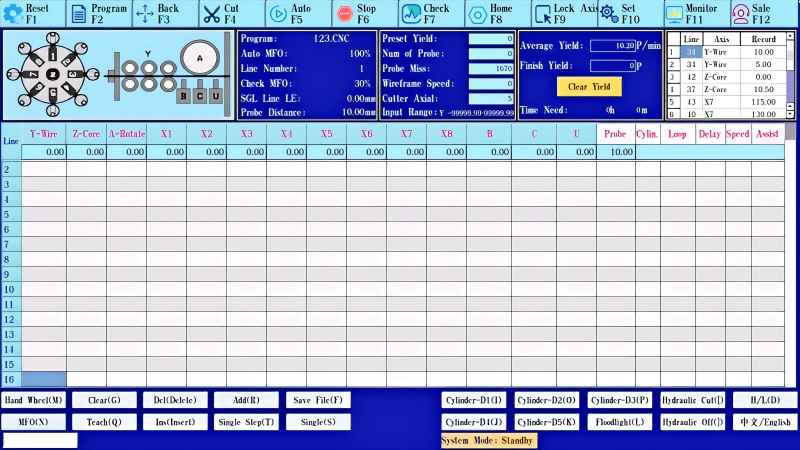
The dual-head synchronized technology operates on a coordinated CNC control architecture. Both bending heads are driven by servo motors and controlled through a unified programming interface. When a program is executed, the two heads move in synchrony, each performing its assigned bending sequence on its respective end of the wire. This synchronization is critical for maintaining dimensional consistency: any deviation in one head's movement is instantly compensated by the control system, ensuring that both ends meet the specified geometry.
The practical benefits of this architecture are measurable. Reducing positioning errors is a direct outcome of eliminating the need to re-clamp or reposition the workpiece mid-process. Shorter production cycle time results from simultaneous rather than sequential end-forming, effectively halving the processing time for symmetrical components. Improved dimensional consistency follows from the CNC-controlled synchronous movement, which maintains tight tolerances across the full length of the workpiece.
Why Automotive Manufacturers Need Double-Head Wire Bending Technology
Higher Efficiency for Long and Symmetrical Wire Components
Automotive wire components share a common characteristic: they tend to be longer and more structurally complex than wire parts used in general industrial applications. Rear seat wire frames typically span 800mm to 1,500mm in length, incorporating multiple bend angles and varying radii along their structure. Seat support structures require precise forming to ensure proper fitment within the seat assembly, while automotive linkage rods demand consistent geometry to maintain reliable mechanical function.
These long wire structures with symmetrical or near-symmetrical designs are where double-head CNC technology delivers its greatest advantage. Processing both ends simultaneously means a rear seat wire frame that would take two positioning cycles on a single-head machine can be completed in one continuous operation. The synchronized forming approach ensures that bend angles at both ends match precisely, eliminating the dimensional drift that can occur with sequential single-end processing. This is particularly valuable for components where symmetry is a functional requirement, not merely a cosmetic preference.
Improved Production Consistency
Production consistency is a core requirement in automotive manufacturing, where component specifications must be met across thousands or millions of units. CNC servo control makes this achievable by replacing mechanical stops and manual positioning with digitally programmed motion profiles. Each bend angle, feed length, and rotation angle is defined in the CNC program and executed identically on every cycle.
The repeatable bending accuracy of a servo-driven double-head machine is typically within plus or minus 0.1 degrees for bend angles and plus or minus 0.1mm for feed lengths, depending on the specific machine configuration and wire material. This level of precision is maintained over extended production runs because the servo motors self-correct based on encoder feedback, compensating for thermal expansion, tool wear, and other variables that can affect mechanical systems. Reduced manual adjustment means fewer operator interventions, less downtime for recalibration, and a more stable production process overall.
Reduced Manual Operations
Modern double-head CNC wire bending machines integrate multiple production steps into a single automated workflow. The process begins with automatic wire feeding, where the wire is drawn from a coil or straightener and advanced to the programmed length. Precision positioning systems then locate the wire between the two bending heads, after which both heads execute their forming sequences simultaneously. Once bending is complete, the cutting mechanism separates the finished component from the wire feed, and the part is ejected onto an output conveyor or collection bin.
This end-to-end automation reduces labor dependency in several ways. One operator can oversee multiple machines because manual loading, positioning, and unloading are eliminated. The consistency of automated processing reduces the need for in-process inspection, as the CNC program ensures every part is formed to the same specification. For manufacturers facing labor shortages or seeking to redeploy skilled workers to higher-value tasks, the automation capability of double-head CNC machines provides a practical pathway to improved operational efficiency.
Automotive Components Suitable for Double-Head CNC Wire Bending Machines
Automotive Seat Frames
Automotive seat frames represent one of the most demanding applications for wire forming technology. These structures must meet strict requirements for dimensional accuracy, structural integrity, and consistent geometry to function correctly within the seat assembly. The wire used in seat frames is typically spring steel or high-carbon steel with diameters ranging from 3.0mm to 6.0mm, requiring robust forming capability. Double-head CNC machines are well-suited to seat frame production because the long, often symmetrical frame components benefit directly from dual-end synchronized forming, reducing cycle time while maintaining the precision needed for reliable assembly fitment.
Rear Seat Wire Frames
Rear seat wire frames are among the largest wire components in a vehicle, often exceeding 1,200mm in length with complex multi-bend geometries. The large symmetrical structures require synchronized bending from both ends to maintain consistent dimensional accuracy across the entire span. High production efficiency requirements in automotive seat manufacturing make double-head CNC machines particularly valuable for these components, as the simultaneous double-end forming approach reduces per-part cycle time compared with sequential processing. The scale of these parts also means that positioning errors during manual handling or single-head forming can have a proportionally larger impact on final dimensions, making automated synchronized processing the more reliable option.
Seat Suspension Wires (Foam Seat Support Wires)
Seat suspension wires, also known as foam seat support wires, provide the structural foundation beneath the seat cushion foam. These components require consistent forming across production volumes because uneven geometry can create pressure points that affect seating comfort and foam durability. Double-head CNC wire bending machines deliver the repeatable production quality essential for these parts, forming each wire to the same specification cycle after cycle. The ability to program and store multiple part configurations also supports flexible production, enabling manufacturers to switch between different seat suspension wire designs without mechanical retooling.
Double Serpentine Springs and Automotive Support Structures
Double serpentine springs and other automotive support structures feature complex wire geometry with continuous bends along the length of the component. These parts require stable forming accuracy to maintain consistent spring characteristics across all units in a production batch. The multi-axis CNC control of a double-head machine enables precise execution of the serpentine pattern, with synchronized movements ensuring uniform bend radii and spacing. For manufacturers producing these components at volume, the combination of automated processing and CNC precision helps maintain the quality consistency that automotive customers demand.
Automotive Linkage Rods
Automotive linkage rods serve as precision connection components in various mechanical systems, including seat adjustment mechanisms, pedal assemblies, and latch systems. Dimensional consistency is critical for these parts because even small deviations can affect the mechanical function of the assembly they belong to. Double-head CNC wire bending machines produce linkage rods with tight tolerances on bend angles and overall length, ensuring reliable fitment and operation. The CNC programmability also supports the production of multiple linkage rod variants on the same machine, reducing the capital investment required for diverse product lines.
Double-Head CNC Wire Bending Machine vs Traditional Wire Forming Process
The differences between traditional wire forming methods and double-head CNC wire bending technology are most apparent when examining specific aspects of the production process. The following comparison highlights the key operational distinctions that impact manufacturing efficiency, product quality, and overall cost-effectiveness.
| Item | Traditional Wire Forming | Double-Head CNC Wire Bending |
|---|---|---|
| Processing Method | One side at a time; multiple repositioning steps required | Simultaneous double-end forming in a single operation |
| Manual Adjustment | More frequent; operator-dependent calibration | Reduced; CNC program-driven parameter control |
| Production Consistency | Depends on operator skill and experience | CNC-controlled repeatability with servo feedback |
| Long Components | Less efficient; multiple clamping and repositioning | Optimized for long structures up to 2,000mm |
| Automation Level | Lower; more manual handling and supervision | Higher; integrated feeding, forming, cutting, and output |
| Cycle Time (Symmetrical Parts) | Longer due to sequential end processing | Shorter; both ends processed simultaneously |
| Changeover Flexibility | Mechanical retooling may be required | Program-based configuration; faster changeover |
How BL-2T-15600 Improves Automotive Wire Production
The BL-2T-15600 Dual-Head CNC Wire Bending Machine from Belan represents a purpose-built solution for automotive wire component manufacturing. Designed specifically for long and symmetrical automotive wire components, this machine combines multi-axis CNC control with dual-head synchronized forming to address the efficiency and precision challenges that automotive manufacturers face in daily production.
At the core of the BL-2T-15600 is a 15-axis CNC control system that provides flexible forming capability across a wide range of wire geometries. Each axis is driven by an independent servo motor, allowing the machine to execute complex bending sequences with coordinated multi-axis movement. The 15-axis configuration enables simultaneous control of wire feed, rotation, bending, and auxiliary movements at both heads, producing components with intricate bend patterns in a single automated cycle.
The dual-head synchronization on the BL-2T-15600 is engineered for production environments where throughput and consistency are equally important. Both bending heads are mounted on a rigid machine structure with precision linear guides, maintaining alignment accuracy over extended production runs. The synchronized control architecture keeps both heads in lockstep throughout the forming cycle, ensuring that bend angles, positions, and radii are consistent from end to end.
The machine handles soft wire in diameters from 3.0mm to 6.0mm and hard wire from 3.0mm to 4.5mm, covering the material specifications commonly used in automotive seat frames, suspension wires, and linkage rods. With a maximum processing length of 2,000mm, the BL-2T-15600 accommodates the full range of automotive wire component sizes, from compact linkage rods to full-size rear seat frames. The total power rating of 26.9KW provides ample forming force for demanding materials, while the machine weight of 5,000KG contributes to the stability required for high-precision forming at production speeds.
In automotive production applications, the BL-2T-15600 is particularly well-suited to manufacturing automotive seat frames, rear seat wire frames, seat suspension wires, foam seat support wires, double serpentine springs, automotive linkage rods, and seat support structures. Each of these applications benefits from the machine's dual-head synchronized forming capability and multi-axis CNC control, enabling manufacturers to produce these components with greater efficiency and consistency than traditional forming methods allow.
How to Determine Whether You Need a Double-Head Wire Bending Machine
Selecting the right wire forming equipment for automotive production requires evaluating several factors related to the components being manufactured and the production environment. A double-head CNC wire bending machine is most advantageous under specific conditions, and understanding these conditions helps manufacturers make an informed investment decision.
A double-head machine is the appropriate choice when components require bending from both ends. If the majority of your wire parts have formed features at both ends, a dual-head configuration can process them in roughly half the cycle time of a single-head machine. Products with symmetrical structures represent another strong case for double-head technology, as the synchronized forming approach ensures matching geometries at both ends without manual adjustment or secondary operations.
Workpieces that are long in size also favor double-head configuration. Components exceeding 800mm in length typically require repositioning on a single-head machine, which adds handling time and introduces potential positioning errors. A double-head machine spanning the full component length can form both ends in one setup, eliminating these intermediate steps. When production volume requires automation, the integrated feeding, positioning, forming, cutting, and output capabilities of a double-head CNC machine reduce labor requirements per part compared with semi-automated or manually assisted processes.
When consistent quality is a non-negotiable requirement, as it is in automotive Tier 1 and Tier 2 supply chains, the CNC-controlled repeatability of a double-head machine provides the process stability that manual or semi-automated methods cannot reliably deliver. For manufacturers producing shorter, simpler wire components with bends at only one end, a standard single-head CNC wire bending machine may be sufficient and more cost-effective. The decision ultimately depends on the specific component geometries, production volumes, and quality requirements of each manufacturing operation.
Why Choose Belan for Automotive Wire Forming Solutions
Belan brings focused automotive wire forming experience to every customer engagement. Having worked with automotive seat manufacturers and Tier 1 suppliers across multiple markets, the company understands the specific challenges of producing wire components for the automotive industry, from material handling requirements to quality documentation standards.
Multi-axis CNC technology forms the foundation of Belan's wire bending equipment portfolio. The company's machines incorporate servo-driven axes with closed-loop feedback, providing the precision and repeatability that automotive production demands. This technology is deployed across a complete wire bending equipment portfolio that includes 3D wire bending machines, 2D wire forming machines, and specialized configurations for specific applications, allowing manufacturers to select the right solution for their production requirements.
Customized tooling solutions address the reality that no two production environments are identical. Belan's engineering team works with customers to develop tooling configurations optimized for their specific component geometries, material specifications, and throughput targets. This collaborative approach extends to technical support, with application engineering resources available to assist customers in automotive parts wire forming process optimization, from initial component feasibility analysis through production ramp-up.
Beyond the equipment itself, Belan provides engineering and technical support that helps manufacturers integrate wire forming machines into their existing production workflows. This includes assistance with layout planning, operator training, and ongoing technical consultation. The goal is to ensure that each machine delivers its intended productivity and quality benefits throughout its service life.
Conclusion
Double-head CNC wire bending machines address core manufacturing challenges that automotive wire component producers face: the need for higher production efficiency, better product consistency, reduced manual operations, and flexible manufacturing capability. By processing both ends of a wire component simultaneously under synchronized CNC control, this technology reduces cycle times for long and symmetrical parts while maintaining the dimensional accuracy that automotive applications require.
For manufacturers evaluating wire forming solutions for automotive seat frames, rear seat wire frames, suspension wires, serpentine springs, or linkage rods, a double-head CNC configuration merits serious consideration. The technology is not a universal solution for every wire forming application, but for the specific geometries and production volumes common in automotive manufacturing, dual-head synchronized forming offers measurable advantages over traditional single-head methods.
The BL-2T-15600 Dual-Head CNC Wire Bending Machine exemplifies how purpose-built automation can improve both production throughput and part quality in automotive wire component manufacturing. With 15-axis CNC control, dual-head synchronized forming, and capacity for wire components up to 2,000mm in length, it provides a capable platform for manufacturers seeking to strengthen their production capabilities.
Request a Customized Automotive Wire Forming Solution
BELAN Machinery, a professional provider of automotive wire forming solutions.
If you are evaluating wire forming equipment for automotive production, Belan's engineering team can help you assess your requirements and identify the optimal machine configuration for your specific components and production targets.