

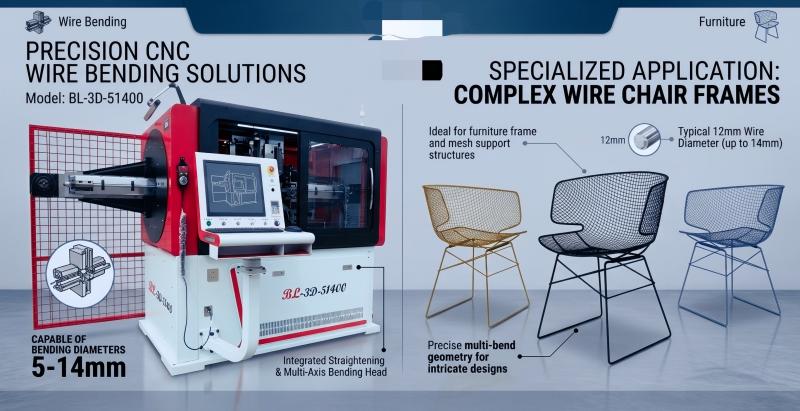
Furniture chair brackets made from 14 mm wire require consistent angles, smooth curve transitions and stable overall dimensions. When a design includes continuous curves, changes in direction or multiple connection angles, the BL-3D-51400 CNC wire bender can combine feeding, straightening, bending and cutting in one continuous forming process. This article explains the main selection considerations for 14mm chair bracket production.
Why 14mm Chair Brackets Are Challenging to Form
Complex angles can create dimensional variation
A chair bracket is not always a simple two-dimensional bend. Depending on the drawing, the part may combine planar bends, spatial turns, radius transitions and end shaping. With manual positioning or several machines used in separate stages, the wire must be moved and corrected repeatedly. This can lead to inconsistent angles, asymmetrical left and right parts and shifted connection points. In furniture products assembled in batches, these variations can affect welding, assembly and finished appearance.
Specification changes add setup time
Furniture hardware orders often include several drawings and small-batch changeovers. Different wire diameters, material hardness levels and bracket dimensions may require new straightening, feeding-length and bending-parameter settings. The ability to reproduce proven parameters quickly is therefore an important part of evaluating an automated forming solution.
How BL-3D-51400 Supports Continuous Forming
As a CNC wire bending machine for 14 mm wire applications, the BL-3D-51400 uses the product drawing to define feeding distance, bend angles, rotation direction and the sequence of operations. After the wire passes through the straightening unit, the feeding system advances it according to the program. The forming head completes multiple bends before the finished length is cut. This reduces manual measuring and repeated repositioning, making the process suitable for continuous furniture bracket production.
Rotary-head forming keeps the wire moving forward and backward
The machine uses a rotary head for three-dimensional forming, while the wire mainly moves forward and backward instead of being frequently rotated during processing. For 14 mm wire, this forming logic can reduce uncertainty caused by material twisting, help stabilize the feeding path and improve control of the spatial relationship between different planes of the bracket. For parts with continuous bends or frequent changes in direction, rotary-head forming also reduces intermediate handling and manual turning.
More forming space helps with multi-angle products
Bracket products may require several angles and different radii within a limited outline. The BL-3D-51400 CNC wire benderprovides a larger forming space so the bending head, tooling and wire can maintain a practical movement range during processing. For chair brackets with a wider structure, longer curved sections or spatial crossings, engineers can plan the motion path from the drawing and reduce the risk of interference.
Graduated Straightening for Faster Changeovers
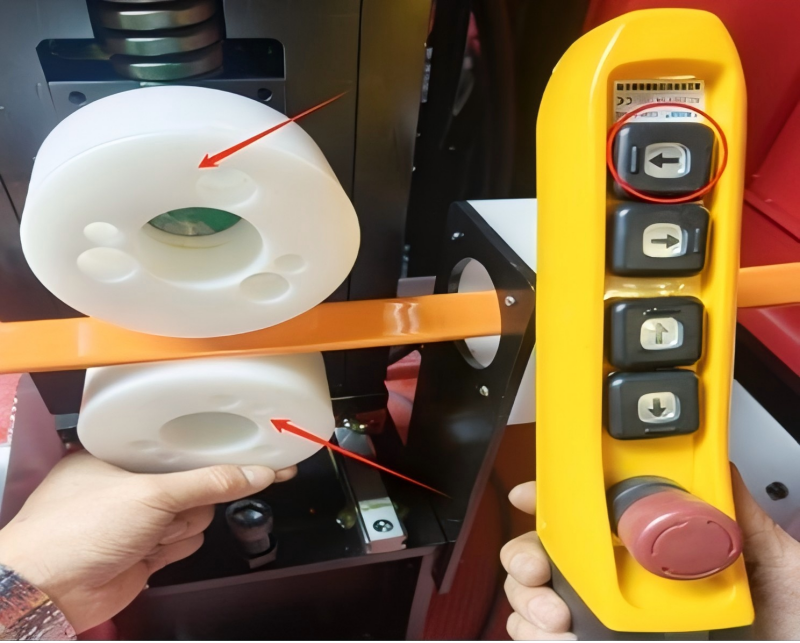
In multi-product production, a CNC wire bender must be easy to return to a stable operating condition, not only capable of complex movements. The straightening structure of the BL-3D-51400 CNC wire bender includes graduations that allow operators to record straightening settings for different wire diameters, materials and products. When the same specification is produced again, the historical setting can be used for a preliminary adjustment, followed by fine-tuning based on a test bend. This can shorten changeover time and reduce repeated trial and error.
This design is particularly useful for furniture factories that produce chair brackets, backrest frames and other wire components at the same time. By keeping internal parameter records, a company can convert individual experience into reusable production data and help new operators learn the basic setup process more quickly.
Multi-Axis Coordination for Complex Curves
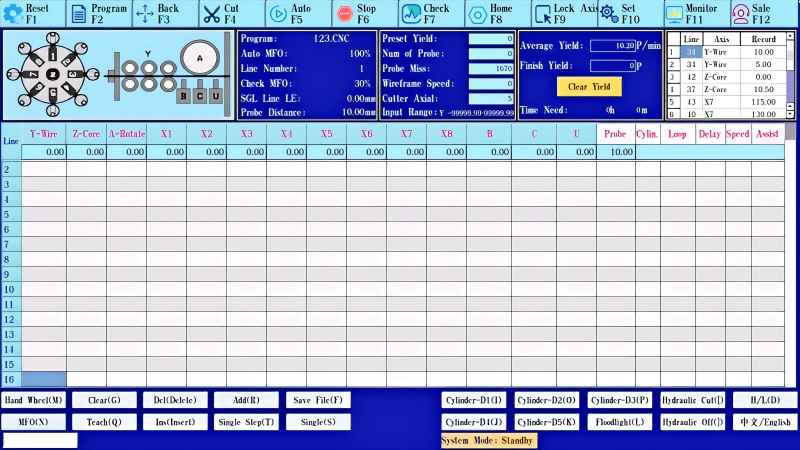
For products with continuous radii, diagonal connections or several spatial changes, a single bending direction may not balance precision and efficiency. The BL-3D-51400 CNC wire bender coordinates feeding, rotation and bending through multiple axes so each movement follows the programmed sequence. Operators can adjust key dimensions and angles in the software, then validate the program with a trial part and gradually optimize the forming result.
The value of multi-axis coordination is not limited to bending speed. It also expands the range of products that the equipment can support. When a furniture customer changes a bracket structure or introduces a new style, the program and tooling can be adjusted for the new drawing, reducing the need for extensive manual work each time the product changes.
A Practical Automation Option for Furniture Brackets
From 14 mm wire to the finished chair bracket, stable feeding, reliable straightening, sufficient movement space and coordinated control all contribute to a consistent forming process. The BL-3D-51400 CNC wire bender brings these steps together in one forming solution. It can be evaluated for repeat production of standard brackets as well as multi-angle, complex-curve and multi-specification applications.
Companies evaluating automated 14mm chair bracket production can contact BELAN with drawings, material, wire diameter, target output and part dimensions. BELAN Machinery, your expert provider of automotive wire forming solutions, can support forming assessment, sample testing and configuration recommendations for furniture, automotive and industrial customers.
For more information about the BL-3D-51400 CNC wire bender, visit the product page or contact our technical team.